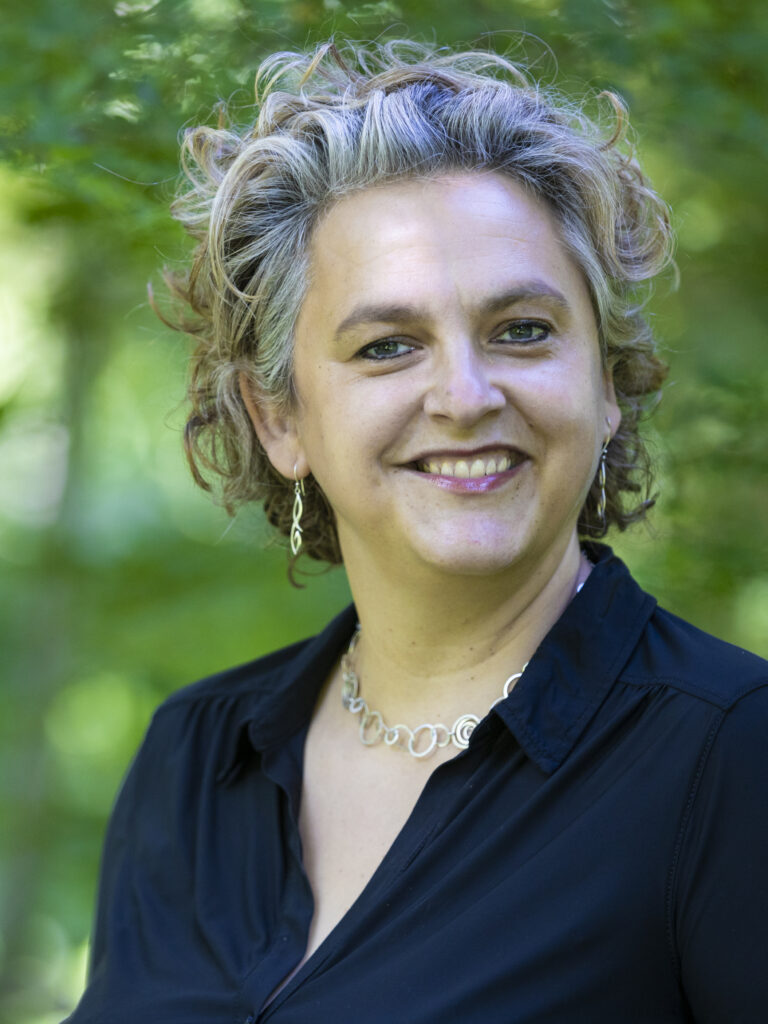
Tine De Moor is professor “Social Enterprise and Institutions for Collective Action” at Rotterdam School of Management, Erasmus University Rotterdam. Previously, she was professor of Institutions for Collective Action in historical perspective at Utrecht University, where she developed an interdisciplinary approach to studying the long-term evolution of rural commons. Her research combines extensive empirical analysis, modelling, and theoretical frameworks to examine institutions for collective action, social enterprises, and the historical development of commons. She is co-founder of the peer-reviewed International Journal of the Commons and has been actively involved in the International Association for the Study of the Commons, serving as President from 2015. De Moor has led and contributed to several internationally recognised research projects, supported by ERC Starting Grants and NWO VIDI and VICI Grants. In 2023, she and her team received Erasmus University’s Open and Responsible Science Award for societal engagement.
Click on the titles below to find more information about Tine De Moor’s work and its relevance to the CoCon project.
A major strength of the CoCon proposal is that it builds on more than two decades of progressively expanding research on institutions for collective action, combining frontier research, digital research infrastructures, stakeholder engagement, and societal impact. Rather than duplicating previous work, CoCon leverages these complementary projects to move beyond individual case studies, historical analyses, and national platforms towards a unified European framework for understanding, comparing, and strengthening citizen collectives. The existing knowledge, datasets, methodological innovations, and stakeholder networks substantially reduce implementation risks while enabling CoCon to address fundamentally new scientific questions at an unprecedented scale.
ECCO – Empowering Citizen COllectives in Societal Transitions (2026–2030, NWO NWA-ORC, €6.8M)
Summary: ECCO investigates how citizen collectives contribute to major societal transitions by combining interdisciplinary research with close collaboration between researchers, governments, civil society organisations, and citizen initiatives.
Relevance to CoCon: ECCO establishes a strong national research and societal network around citizen collectives, providing valuable empirical insights, stakeholder engagement, and opportunities for knowledge exchange. CoCon significantly extends this foundation by developing a comparative European framework, integrating historical and contemporary perspectives, and advancing fundamental theories and digital research infrastructures that go well beyond ECCO’s national transition-oriented focus.
CROWN – Collaborative Research Open Workspace for Networked Data (Open Science NL, €1.5M)
Summary: Develops an advanced open science infrastructure for collaborative research, enabling researchers to create, manage, and analyse interoperable datasets in accordance with FAIR principles.
Relevance to CoCon: CROWN provides essential technical expertise and infrastructure for collaborative data management and open science. CoCon builds upon these capabilities to develop the CollectivePower platform as a domain-specific European research infrastructure for institutions for collective action, integrating historical and contemporary datasets with innovative AI-supported analytical tools.
UNICA – Building a Unified Theory for the Development and Resilience of Institutions for Collective Action for Europe in the Past Millennium (2020–2027, NWO VICI, €1.5M)
Summary: Develops a comprehensive theoretical and empirical framework explaining the emergence, development, and resilience of institutions for collective action over the past millennium, combining comparative historical research with innovative computational methods.
Relevance to CoCon: UNICA provides the principal scientific foundation for CoCon by generating theories, datasets, and methodological innovations concerning institutions for collective action. CoCon does not replicate this work, but substantially expands it by moving from historical analysis towards an integrated European framework that includes contemporary citizen collectives, develops AI-supported comparative methodologies, and translates scientific knowledge into practical tools for policymakers and civil society.
CollectieveKracht Platform (2020–2027, multiple funders, €1.35M)
Summary: Established and further developed the Netherlands’ leading knowledge exchange platform on citizen collectives, bringing together researchers, policymakers, practitioners, and citizen initiatives while facilitating knowledge sharing, networking, and public engagement.
Relevance to CoCon: CollectieveKracht demonstrates the feasibility and societal value of sustained collaboration between science and practice. CoCon builds upon this successful model by creating a European knowledge infrastructure that connects research communities and citizen collectives across countries while integrating advanced comparative datasets and analytical tools that substantially broaden both the scientific scope and international impact.
Knowledge Brokering for CollectieveKracht (2024–2025, NWO Impact Explorer & Adessium Foundation)
Summary: Developed approaches for systematically documenting, preserving, and mobilising knowledge generated by Dutch citizen collectives, strengthening institutional memory and long-term learning.
Relevance to CoCon: This project provides practical experience in knowledge brokerage and long-term knowledge preservation. CoCon extends these principles to a European scale through the development of sustainable research infrastructures and knowledge platforms supporting comparative research and evidence-based policymaking.
DAZO – Van Incidentele Subsidies naar Kostenvermijdende Financiering (2026, €49K)
Summary: Explores innovative financing models that enable neighbourhood initiatives and citizen collectives to move beyond short-term subsidies towards sustainable, preventive forms of financing.
Relevance to CoCon: DAZO contributes practical insights into the institutional and financial sustainability of citizen collectives. CoCon places these experiences within a broader comparative framework by analysing how governance, financing, and institutional design interact across diverse European contexts.
United We Stand – The Dynamics and Consequences of Institutions for Collective Action in Pre-Industrial Europe (2009–2014, ERC Starting Grant, €1.2M)
Summary: Established one of the first large-scale comparative research programmes on historical institutions for collective action, investigating their emergence, governance, and long-term societal effects across Europe.
Relevance to CoCon: This pioneering ERC project laid the scientific foundations for much of the subsequent research on institutions for collective action. CoCon capitalises on these achievements by extending the analytical framework to contemporary citizen collectives, incorporating new computational methods, and addressing pressing societal challenges through interdisciplinary and comparative research.
Common Rules – The Regulation of Institutions for Managing Commons in Europe 1100–1800 (2011–2015, NWO Internationalisation Grant)
Summary: Developed the internationally unique Common Rules Database by systematically coding historical governance rules using Institutional Grammar, creating one of the first machine-readable comparative datasets on commons.
Relevance to CoCon: The project introduced an innovative methodology for transforming complex institutional rules into structured data suitable for computational analysis. CoCon builds directly upon this methodological innovation by extending rule-based analysis to contemporary citizen collectives and integrating AI-supported approaches for comparative institutional research.
Data Infrastructure for the Study of Guilds and Other Forms of Corporate Collective Action in Pre-Industrial Times (2007–2011, NWO Infrastructure Grant, €600K)
Summary: Established one of Europe’s first large-scale digital research infrastructures for historical institutions for collective action, creating interoperable datasets on guilds and related organisations.
Relevance to CoCon: This project pioneered the development of digital infrastructures for comparative institutional research and established many of the FAIR data principles that underpin CoCon. The proposed project substantially broadens this infrastructure by integrating multiple institutional types, contemporary citizen collectives, and AI-supported analytical capabilities within a European research ecosystem.
Sustainable Cooperation (SCOOP) (2017–2025, NWO Gravitation Programme, €18.8M)
Summary: Contributed to an interdisciplinary national research programme investigating the conditions under which cooperation can emerge and persist across diverse social, economic, and environmental settings.
Relevance to CoCon: SCOOP provides important interdisciplinary perspectives on cooperation and collective behaviour. CoCon complements this work by focusing specifically on institutions for collective action and by developing comparative historical and contemporary analyses that translate insights on cooperation into institutional design principles for resilient citizen collectives
Knowledge Brokering to Build the Memory of Dutch Citizen Collectives as Part of the CollectieveKracht Platform (2024–2025, NWO Impact Explorer & Adessium Foundation, €60K)
Summary: This project developed innovative approaches for capturing, preserving, and mobilising the knowledge generated by Dutch citizen collectives. By strengthening institutional memory and facilitating knowledge exchange between citizen initiatives, researchers, and policymakers, it explored how experiential knowledge can be transformed into a lasting public resource that supports learning and innovation across the sector.
Relevance to CoCon: The project provides valuable experience in translating scientific knowledge into practical tools and sustainable knowledge infrastructures for citizen collectives. It established approaches for knowledge brokerage, stakeholder engagement, and long-term knowledge preservation that will be expanded in CoCon through the development of the European CollectivePower platform. While the Impact Explorer project focused on strengthening knowledge exchange within the Netherlands, CoCon scales this approach to the European level by integrating comparative datasets, AI-supported analysis, and transnational communities of practice.
Nature or Nurture? A Search for the Institutional and Biological Determinants of Life Expectancy in Europe During the Early Modern Period (2013–2018, NWO VIDI, €800K)
Summary: This interdisciplinary VIDI project combined historical demography, economic history, institutional analysis, and life sciences to investigate how institutional and biological factors jointly shaped variations in health and life expectancy across early modern Europe. The project introduced innovative methods for integrating large-scale historical datasets from multiple disciplines to study long-term societal development.
Relevance to CoCon: Although focusing on historical health outcomes rather than citizen collectives, the project demonstrates Tine De Moor’s pioneering expertise in integrating diverse datasets, disciplines, and analytical methods to address complex societal questions. The experience gained in combining historical evidence, computational approaches, and interdisciplinary collaboration provides an important methodological foundation for CoCon’s ambition to integrate historical and contemporary data sources, develop novel analytical frameworks, and investigate the societal impact of institutions for collective action across Europe.
United We Stand – The Dynamics and Consequences of Institutions for Collective Action in Pre-Industrial Europe (2009–2014, ERC Starting Grant, €1.2M)
Summary: This pioneering ERC Starting Grant established one of the first large-scale European research programmes dedicated to the comparative study of institutions for collective action. Combining historical analysis, institutional theory, and the development of innovative digital datasets, the project investigated how commons, guilds, and other forms of self-governance emerged, functioned, adapted, and contributed to long-term economic and social development across Europe.
Relevance to CoCon: United We Stand laid the scientific foundations for Tine De Moor’s internationally recognised research programme on institutions for collective action. It generated novel theories, comparative datasets, and methodological innovations that have since become central to the field. CoCon builds upon this foundation by moving beyond historical institutions towards an integrated analysis of both historical and contemporary citizen collectives, introducing AI-supported comparative methodologies, expanding the geographical and societal scope, and translating scientific insights into practical tools and policy-relevant knowledge through the CollectivePower platform. Rather than revisiting earlier questions, CoCon leverages the scientific infrastructure and conceptual advances established by the ERC project to address an entirely new generation of research challenges.
Books
De Moor, T., Held, M. & Steijaert, M. (2025). Burgercollectieven-monitor 2025 van CollectieveKracht. Nederlandse burgercollectieven in kaart gebracht
Summary: Presents the first large-scale national monitoring of Dutch citizen collectives, documenting their distribution, governance, organisational characteristics, sectors of activity, and societal impact.
Relevance to CoCon: Provides a unique empirical evidence base on the diversity, development, and resilience of citizen collectives. The monitoring approach directly supports CoCon’s ambition to build robust comparative datasets and understand the institutional evolution of citizen collectives across sectors and over time.
De Moor, T., Czischke, D., van Eijk, C., Groep-Foncke, M., Held, L., Horlings, I., Jans, L., Kleinhans, R. & van Meerkerk, I. (2025). Burgercollectieven aan het roer? In co-creatie met de overheid naar succesvolle transities
Summary: Examines how citizen collectives and governments can collaborate effectively to address societal transitions, identifying institutional conditions for successful co-creation and collaborative governance.
Relevance to CoCon: Demonstrates expertise in citizen collectives, collaborative governance, and institutional innovation. The report directly informs CoCon’s work on the interaction between citizen initiatives and public institutions in enabling sustainable societal transitions.
De Moor, T. (2024). Essay: Hoe waarde weerbaar wordt. Bouwen aan de gemeenschapseconomie in Rotterdam
Summary: Explores how citizen collectives contribute to a resilient community economy by creating shared value, strengthening local cooperation, and fostering democratic participation and collective ownership.
Relevance to CoCon: Demonstrates expertise in community economies, citizen collectives, collaborative governance, and the translation of historical knowledge on commons into contemporary policy and practice, directly supporting CoCon’s work on resilient institutions for collective action.
De Moor, T. (2023). Shakeholder society? Social enterprises, citizens and collective action in the community economy (Inaugural Lecture)
Summary: Introduces the concept of the “shakeholder society,” arguing that resilient economies require collaboration between citizens, social enterprises, governments, and other societal actors through institutions based on collective action and shared value creation.
Relevance to CoCon: Provides an overarching conceptual framework for understanding community economies, citizen collectives, and collaborative governance. It directly underpins CoCon’s ambition to study how institutions for collective action contribute to resilient, democratic, and sustainable societal transitions.
Haller, T., Breu, T., De Moor, T., Rohr, C. & Znoj, H. (eds.) (2019). Commons in a ‘Glocal’ World: Global Connections and Local Responses
Summary: This edited volume examines commons across diverse geographical and institutional contexts, analysing how local collective action responds to global environmental, economic, and political challenges.
Relevance to CoCon: Demonstrates international leadership in comparative commons research and highlights how institutions for collective action adapt across cultures and governance settings. The volume strengthens CoCon’s comparative perspective on institutional diversity, resilience, and the global relevance of citizen collectives.
De Moor, T. (2015). The Dilemma of the Commoners. Understanding the Use of Common-Pool Resources in a Long-Term Perspective
Summary: This monograph develops a long-term historical perspective on the emergence, functioning, adaptation, and decline of commons, explaining how institutions for collective action evolve to manage shared resources sustainably over centuries.
Relevance to CoCon: This is one of the foundational scholarly works underlying CoCon. It provides the theoretical and historical framework for understanding institutional evolution, resilience, self-governance, and collective action, all of which form the intellectual core of the project.
De Moor, T. (2013). Homo cooperans. Institutions for Collective Action and the Compassionate Society (Inaugural Lecture)
Summary: Introduces the concept of Homo cooperans, arguing that cooperation and collective action are fundamental characteristics of human societies and that institutions for collective action are essential for building resilient, compassionate, and sustainable communities.
Relevance to CoCon: Establishes the conceptual foundation for CoCon by positioning cooperation, citizen self-organization, and institutional diversity at the centre of societal resilience. The lecture articulates the long-term research agenda that CoCon further develops through comparative historical and contemporary analyses of citizen collectives.
Articles in peer-reviewed journals
De Moor, T. & Van Klingeren, F. (2025). Contagious Institutions? A Longitudinal Study of Institutional Spill-Over of European Guilds
Summary: Demonstrates that institutions spread primarily through processes of institutional diffusion rather than through favourable economic or political conditions. By analysing the diffusion of European guilds, the study identifies learning and competition as the principal mechanisms through which institutions spread across regions and shows that long-term resilience depends on coordination beyond the local level.
Relevance to CoCon: This paper is particularly important for CoCon because it provides a new theoretical framework for understanding not only why citizen collectives emerge, but also how they spread, scale, coordinate, and remain resilient. It introduces institutional diffusion as a central explanatory mechanism and identifies institutional contagion, amplification, network formation, and meta-governance as key research themes. The study forms a direct bridge between historical institutions such as guilds and contemporary citizen collectives and provides one of the strongest theoretical foundations for CoCon’s research on the emergence, scaling, networking, and long-term resilience of institutions for collective action.
De Moor, T. & Groep-Foncke, M. (2025). Easily accessible (small) LLMs in historical studies: opportunities, limitations, pitfalls
Summary: Explores how small open-source large language models can support the extraction and coding of institutional rules from historical governance documents while maintaining human oversight and scientific transparency.
Relevance to CoCon: Demonstrates methodological leadership in combining AI, institutional analysis, and digital humanities. The approach directly supports CoCon’s ambition to analyse the statutes and governance documents of thousands of citizen collectives through transparent, AI-assisted rule coding, making large-scale comparative institutional analysis feasible.
De Herde, V. & De Moor, T. (2025). The Hitchhiker’s Guide to the Organizational Galaxy: Overcoming Challenges of Data Aggregation over Time and Space
Summary: Develops a methodology for harmonising organisational data across countries, historical periods, and archival traditions while preserving contextual richness and ensuring FAIR data standards.
Relevance to CoCon: Provides the methodological basis for building interoperable European datasets on citizen collectives. The expertise in data harmonisation, longitudinal comparison, and FAIR research infrastructures directly underpins CoCon’s comparative research infrastructure.
Santamaría Echeverría, E. & De Moor, T. (2025). Unlocking Our Common Body? Biological Materials, Data and Knowledge Commons for Research & Development
Summary: Examines biological materials, scientific data, and knowledge as commons, exploring governance arrangements that enable collective stewardship while balancing openness, innovation, and intellectual property.
Relevance to CoCon: Broadens CoCon’s understanding of commons beyond local resource management by demonstrating how principles of collective governance can be applied to emerging knowledge and data commons. It contributes to CoCon’s conceptual framework on institutional diversity and governance across different types of commons.
Bunders, D.J. & De Moor, T. (2024). Using the Institutional Grammar to Understand Collective Resource Management in a Heterogeneous Cooperative Facing External Shocks
Summary: Analyses more than 400 formal rules of Smart Belgium using the Institutional Grammar framework to understand how heterogeneous cooperatives govern collective resources and respond to crises such as COVID-19 and regulatory change.
Relevance to CoCon: This publication is one of the methodological cornerstones of CoCon. It demonstrates how institutional rules can be systematically analysed to understand governance, adaptation, and resilience in citizen collectives. The paper provides the analytical framework that CoCon will apply to compare governance arrangements across citizen collectives in different sectors and countries. It also establishes expertise in empirical rule coding, institutional analysis, and organisational resilience that directly supports CoCon’s comparative analysis of institutional design and long-term resilience.
Wittenberg, K., Corten, R., Van der Lippe, T. & De Moor, T. (2024). The Emergence of Citizen Collectives for Care: The Role of Social Cohesion
Summary: Examines how social cohesion, trust, and shared identity create the conditions for the emergence of care collectives, demonstrating that collective action is rooted in community-level social dynamics rather than individual motivations alone.
Relevance to CoCon: This study directly addresses one of CoCon’s central research questions: why citizen collectives emerge. By identifying the social mechanisms that enable citizens to organise collectively, it provides an empirical foundation for explaining the emergence of institutions for collective action across sectors. The findings on trust, shared identity, and community self-organisation are fundamental for CoCon’s comparative research on the development and resilience of citizen collectives.
Van Klingeren, F. & De Moor, T. (2024). Ecological, Financial, Social and Societal Motives for Cooperative Energy Prosumerism
Summary: Investigates why citizens participate in an energy cooperative, demonstrating that participation is shaped by a combination of ecological, financial, social, and societal motivations.
Relevance to CoCon: Provides empirical evidence on member motivations and institutional resilience, demonstrating how citizen collectives must balance diverse interests to maintain participation and legitimacy. The findings contribute directly to CoCon’s research on participation, governance, and long-term sustainability of citizen collectives.
Prats Lopez, M., Rijpma, A. & De Moor, T. (2023). Behind the Crowdsourcing Platform: Assessing Volunteer Recruitment and Engagement Instruments
Summary: Examines which organisational strategies are most effective in recruiting and retaining volunteers on large crowdsourcing platforms, highlighting the importance of community management, feedback, and intrinsic motivation.
Relevance to CoCon: Provides practical and scientific expertise for designing the CollectivePower platform. The findings inform CoCon’s participatory approach by identifying how to build and sustain an engaged community of citizens, researchers, and practitioners contributing to collaborative knowledge production.
Bunders, D.J. & De Moor, T. (2023). Paradoxical Tensions as a Double-Edged Sword: Analysing the Development of Platform Cooperatives in the European Gig Economy
Summary: Analyses how platform cooperatives navigate tensions between democratic governance, economic viability, technological innovation, and market competition.
Relevance to CoCon: Demonstrates expertise in emerging forms of collective organisation and institutional innovation. The study contributes to CoCon’s understanding of how citizen collectives balance competing objectives while maintaining democratic governance and organisational resilience.
De Moor, T. & Duffhues, T. (2022). Reflecties over de rol van de reactieve burger in een wereld in crisis
Summary: Reflects on the surge of citizen initiatives during the COVID-19 pandemic and analyses how citizen self-organisation complements formal governmental responses in times of crisis.
Relevance to CoCon: Demonstrates the importance of institutions for collective action in strengthening societal resilience during periods of disruption. The paper provides a conceptual foundation for CoCon’s research on the interaction between citizen collectives and public authorities and highlights the role of self-organisation, collaborative governance, and adaptive capacity in addressing complex societal challenges.
Bunders, D.J., Arets, M., Frenken, K. & De Moor, T. (2022). The Feasibility of Platform Cooperatives in the Gig Economy
Summary: Examines the institutional, financial, and organisational conditions under which platform cooperatives can compete with investor-owned digital platforms, developing a taxonomy of platform cooperatives and analysing their governance challenges.
Relevance to CoCon: Demonstrates expertise in digitally enabled citizen collectives and democratic platform governance. The study contributes to CoCon’s understanding of how digital technologies can support collective action while preserving democratic governance, participation, and long-term organisational sustainability.
Ale Ebrahim Dehkordi, M., Ghorbani, A., Bravo, G., Farjam, M., Van Weeren, R., Forsman, A. & De Moor, T. (2021). Long-Term Dynamics of Institutions: Using ABM as a Complementary Tool to Support Theory Development in Historical Studies
Summary: Combines historical datasets on commons with agent-based modelling to investigate the mechanisms underlying the emergence, evolution, and persistence of institutions for collective action.
Relevance to CoCon: Provides an innovative methodological foundation for CoCon by demonstrating how computational modelling can complement empirical research to explain institutional emergence, adaptation, and resilience. The approach offers valuable opportunities for developing and testing theories about the long-term dynamics of citizen collectives.
Vriens, E., Buskens, V. & De Moor, T. (2021). Networks and New Mutualism: How Embeddedness Influences Commitment and Trust in Small Mutuals
Summary: Analyses more than 5,000 members of Dutch mutual organisations to demonstrate how social networks strengthen trust, commitment, and long-term participation.
Relevance to CoCon: Provides empirical evidence on the social foundations of resilient citizen collectives. The findings demonstrate that trust and social embeddedness are essential for sustaining participation and organisational resilience, directly informing CoCon’s work on the social dynamics of institutions for collective action.
De Moor, T., Farjam, M., Van Weeren, R., Bravo, G., Forsman, A., Ghorbani, A. & Ale Ebrahim Dehkordi, M. (2021). Taking Sanctioning Seriously: The Impact of Sanctions on the Resilience of Historical Commons in Europe
Summary: Investigates how sanctioning contributes to the resilience of historical commons, demonstrating that successful collective institutions rely on carefully balanced governance systems rather than frequent punishment.
Relevance to CoCon: Provides important insights into institutional design and the governance mechanisms that sustain long-term cooperation. The findings help explain how citizen collectives can balance trust, monitoring, and accountability while maintaining resilience across changing institutional environments.
Forsman, A., De Moor, T., Van Weeren, R., Farjam, M., Ale Ebrahim Dehkordi, M., Ghorbani, A. & Bravo, G. (2021). Comparisons of Historical Dutch Commons Inform about the Long-Term Dynamics of Social-Ecological Systems
Summary: Explores how institutional arrangements, ecological dynamics, and collective behaviour co-evolve over time, demonstrating the interconnected development of social and ecological systems.
Relevance to CoCon: Particularly relevant for CoCon’s work on environmental literacy and adaptive governance. The study demonstrates that environmental stewardship develops through participation in collective institutions and provides a long-term perspective on how institutions foster collective learning, sustainable behaviour, and resilience in social-ecological systems.
Forsman, A., Ale Ebrahim Dehkordi, M., Bravo, G., De Moor, T., Farjam, M., Ghorbani, A. & Van Weeren, R. (2020). Eco-Evolutionary Perspectives on Emergence, Dispersion and Dissolution of Historical Dutch Commons
Summary: Applies an eco-evolutionary perspective to explain how institutions for collective action emerge, spread, adapt, and disappear in response to changing social and environmental conditions.
Relevance to CoCon: Demonstrates expertise in institutional evolution and adaptive governance by showing how collective institutions continuously evolve through processes of learning, diffusion, and selection. The study provides valuable theoretical insights into the long-term development and resilience of citizen collectives.
Vriens, E. & De Moor, T. (2020). Mutuals on the Move: Exclusion Processes in the Welfare State and the Rediscovery of Mutualism
Summary: Compares historical and contemporary mutual organisations to examine how democratic self-governance and solidarity evolve in response to changing welfare systems.
Relevance to CoCon: Demonstrates how citizen collectives emerge to address societal needs that are insufficiently met by public or market institutions. The study contributes to CoCon’s understanding of institutional adaptation, solidarity, and organisational innovation in changing governance contexts.
Bravo, G., De Moor, T., Farjam, M., Van Weeren, R., Ghorbani, A., Ale Ebrahim Dehkordi, M. & Forsman, A. (2020). Shared Patterns in Long-Term Dynamics of Commons as Institutions for Collective Action
Summary: Identifies common patterns in the development of historical commons over seven centuries, demonstrating that institutions for collective action follow recognisable life cycles of emergence, stabilisation, and adaptation.
Relevance to CoCon: This publication is particularly important for CoCon because it provides one of the strongest empirical demonstrations that institutions for collective action evolve according to identifiable developmental trajectories. It directly supports CoCon’s ambition to understand how citizen collectives emerge, mature, adapt, and remain resilient over time. The study also provides a comparative framework for analysing institutional life cycles and governance evolution across different sectors and countries.
Labanca, N., Guimarães Pereira, A., Watson, M., Krieger, K., Padovan, D., Watts, L., Moezzi, M., Wallenborn, G., Wright, R., Laes, E., Fath, B.D., Ruzzenenti, F., De Moor, T., Bauwens, T. & Mehta, L. (2020). Transforming Innovation for Decarbonisation? Insights from Combining Complex Systems and Social Practice Perspectives
Summary: Argues that successful sustainability transitions depend on social innovation, collective action, and institutional change rather than technological innovation alone.
Relevance to CoCon: Provides a conceptual foundation for CoCon’s work on environmental literacy and sustainability transitions. The paper demonstrates how citizen collectives contribute to behavioural change, collective learning, and adaptive governance through participation in community-based institutions.
De Moor, T., Rijpma, A. & Prats López, M. (2019). Dynamics of Engagement in Citizen Science: Results from the “Yes, I do!” Project
Summary: Investigates how citizen science projects can recruit, engage, and retain volunteers over the long term through effective feedback, recognition, and community building.
Relevance to CoCon: Provides direct methodological expertise for the design of CoCon’s CollectivePower platform. The findings inform how to build sustainable participatory research infrastructures that engage citizens in collaborative data collection, knowledge creation, and collective learning.
Vriens, E., Buskens, V. & De Moor, T. (2019). A Network Perspective on Small Mutual Insurance Groups: How Embeddedness Influences Trust and Commitment
Summary: Demonstrates how social embeddedness strengthens trust, commitment, and participation within mutual organisations through empirical network analysis.
Relevance to CoCon: Provides valuable evidence that resilient institutions depend not only on governance rules but also on strong social relationships and community networks. The findings support CoCon’s research on participation, collective learning, trust, and environmental literacy within citizen collectives.
De Moor, T. (2018). Revealing Historical Resilience (in Tragedy Revisited, Science)
Summary: Demonstrates how historical analyses of commons reveal the conditions under which institutions for collective action remain resilient through continuous learning, adaptation, and institutional innovation.
Relevance to CoCon: This is one of the most influential publications underpinning CoCon. Published in Science, it establishes international leadership in the study of institutional resilience and demonstrates why historical commons provide essential lessons for contemporary citizen collectives. The paper provides a key conceptual foundation for CoCon’s research on institutional resilience, adaptive governance, collective learning, and environmental literacy, while showcasing the international scientific impact of this research programme.
Laborda Peman, M. & De Moor, T. (2016). History and the Commons: A Necessary Conversation
Summary: Explores how historical commons research can be integrated with theories of collective action to understand institutional adaptation and resilience over time.
Relevance to CoCon: Demonstrates the importance of combining historical and contemporary perspectives to explain the emergence and evolution of institutions for collective action. The paper provides an interdisciplinary foundation for CoCon’s comparative approach to citizen collectives.
De Moor, T., Lana Berasaín, J.M., Laborda Peman, M., Van Weeren, R. & Winchester, A. (2016). Ruling the Commons: Introducing a New Methodology for the Analysis of Historical Commons
Summary: Introduces the Common Rules framework for systematically coding and comparing the governance rules of historical commons across countries and time periods.
Relevance to CoCon: This publication is a cornerstone of CoCon’s methodological approach. The Common Rules framework provides the analytical language for comparing governance arrangements across citizen collectives and forms the basis for CoCon’s AI-assisted institutional analysis. It is fundamental to the project’s ambition to build harmonised, interoperable datasets and conduct large-scale comparative research on institutions for collective action.
De Moor, T. & Van Weeren, R. (2014). Controlling the Commoners: Methods to Prevent, Detect, and Punish Free-Riding on Dutch Commons in the Early Modern Period
Summary: Examines how historical commons prevented free-riding through balanced systems of monitoring, community oversight, and graduated sanctions.
Relevance to CoCon: Demonstrates expertise in institutional design and governance mechanisms that sustain cooperation over long periods. The findings directly inform CoCon’s analysis of governance arrangements that enable citizen collectives to remain trustworthy, effective, and resilient.
De Moor, T. (2014). Single, Safe, and Sorry? Explaining the Early Modern Beguine Movement in the Low Countries
Summary: Analyses the emergence of Beguine communities as innovative institutions that combined mutual support, economic cooperation, and social autonomy for women.
Relevance to CoCon: Demonstrates how citizen-led institutions emerge in response to unmet societal needs while promoting inclusion, self-governance, and organisational resilience. The study strengthens CoCon’s understanding of institutional diversity and the historical roots of contemporary citizen collectives.
Laborda Pemán, M. & De Moor, T. (2013). A Tale of Two Commons: Some Preliminary Hypotheses on the Long-Term Development of the Commons in Western and Eastern Europe, 1000–1900
Summary: Compares the historical development of commons across Western and Eastern Europe to explain how different institutional trajectories emerge under varying political, economic, and social conditions.
Relevance to CoCon: Provides an important comparative perspective for understanding why citizen collectives develop differently across Europe. The study highlights the importance of institutional diversity and historical context, directly supporting CoCon’s comparative European research programme.
De Moor, T. (2012). Von der Allmende zu Globalen Commons: Eine historische Analyse interdisziplinärer Annäherungen an die Commons
Summary: Traces the development of commons research from local resource governance to contemporary global commons, demonstrating the continued relevance of collective action across multiple governance scales.
Relevance to CoCon: Provides an overarching conceptual framework that links local citizen collectives to wider societal and environmental challenges. The paper strengthens CoCon’s interdisciplinary perspective on commons, environmental literacy, institutional innovation, and governance across scales.
De Moor, T. (2012). What Do We Have in Common? A Comparative Framework for Old and New Literature on the Commons
Summary: Develops a comparative framework that brings together historical and contemporary commons research, demonstrating the common principles underlying diverse forms of collective governance, from historical commons to digital, urban, and knowledge commons.
Relevance to CoCon: This publication is highly relevant for CoCon because it provides the overarching conceptual framework that enables comparison across the wide diversity of citizen collectives studied in the project. It establishes the theoretical basis for analysing energy communities, care collectives, housing cooperatives, platform cooperatives, and other institutions for collective action within a single analytical framework, making it one of the key conceptual foundations of CoCon.
De Moor, T. (2011). From Common Pastures to Global Commons: A Historical Perspective on Interdisciplinary Approaches to Commons
Summary: Traces the historical evolution of commons from local resource management to global commons governance, highlighting the continued relevance of collective action across scales and disciplines.
Relevance to CoCon: Demonstrates expertise in integrating historical, social, ecological, and governance perspectives on commons. The paper strengthens CoCon’s interdisciplinary framework and contributes to its work on environmental literacy, adaptive governance, and collective learning.
De Moor, T. (2010). Participation Is More Important than Winning
Summary: Shows that the long-term resilience of historical commons depended primarily on broad and meaningful participation in governance rather than on the distribution of economic benefits.
Relevance to CoCon: Particularly relevant for CoCon’s work on participation and democratic governance. The study demonstrates that active participation is a key determinant of institutional resilience and provides important historical evidence for understanding why citizen engagement is essential for successful institutions for collective action.
De Moor, T. & Van Zanden, J.L. (2010). Girlpower
Summary: Analyses how demographic structures, women’s labour market participation, and socio-economic development created favourable conditions for institutional innovation and collective organisation.
Relevance to CoCon: Provides important contextual insights into the societal conditions that facilitate the emergence of institutions for collective action. The study contributes to CoCon’s understanding of inclusion, gender, and the broader social preconditions for citizen self-organisation.
De Moor, T. & Van Zanden, J.L. (2010). Every Woman Counts
Summary: Examines gender differences in numeracy in the early modern Low Countries and demonstrates the importance of literacy and human capital for economic participation and civic engagement.
Relevance to CoCon: Contributes to CoCon’s perspective on environmental literacy by showing that knowledge and learning are fundamental capacities underpinning participation in collective institutions and democratic governance.
De Moor, T. (2010). De rol van instituties voor collectieve actie in de vroegmoderne samenleving
Summary: Provides a conceptual overview of the role of institutions for collective action in early modern society, highlighting their importance in governing shared resources, managing risks, and fostering cooperation.
Relevance to CoCon: Establishes the historical foundations of CoCon’s research programme by demonstrating that institutions for collective action have long been fundamental building blocks of resilient societies.
De Moor, T. (2009). Avoiding Tragedies
Summary: Examines how a Flemish common successfully adapted to major socio-economic change, demonstrating that commons avoided institutional failure through adaptive governance and continued citizen participation.
Relevance to CoCon: This publication is particularly important because it directly addresses one of CoCon’s central research questions: why some institutions for collective action remain resilient while others decline. The study provides compelling historical evidence that resilience depends on adaptive governance, participation, and institutional learning rather than on static institutional designs. It forms an important empirical foundation for CoCon’s work on institutional resilience and governance.
Van Bavel, B., De Moor, T. & Van Zanden, J.L. (2008). The Institutional Organization of Land Markets
Summary: Examines how markets are embedded within wider institutional frameworks of property rights, governance, and social norms.
Relevance to CoCon: Demonstrates that citizen collectives operate within broader institutional ecosystems. The study strengthens CoCon’s comparative perspective on the interaction between markets, governments, and institutions for collective action.
De Moor, T. & Van Zanden, J.L. (2008). Van fouten kan je leren
Summary: Develops robust methods for reconstructing historical numeracy while highlighting the importance of literacy and methodological rigour in long-term comparative research.
Relevance to CoCon: Provides methodological expertise relevant to CoCon’s work on environmental literacy and historical comparative research, demonstrating how human capabilities underpin participation in institutions for collective action.
Lucassen, J., De Moor, T. & Van Zanden, J.L. (2008). The Return of the Guilds
Summary: Introduces a global comparative perspective on guilds, demonstrating how self-governing associations emerged across different institutional and cultural settings.
Relevance to CoCon: Provides an important comparative foundation for analysing institutional diversity across Europe and beyond. The study contributes directly to CoCon’s ambition to understand how different institutional contexts shape the emergence and evolution of citizen collectives.
De Moor, T. (2008). The Silent Revolution
Summary: Introduces the concept of the “Silent Revolution” to explain the widespread emergence of commons, guilds, and other forms of collective organisation in medieval and early modern Europe.
Relevance to CoCon: This publication is one of the landmark conceptual works underpinning CoCon. It demonstrates that institutions for collective action emerged as part of a broader process of institutional innovation driven by cooperation and self-governance. The paper provides a powerful historical explanation for the emergence and diffusion of citizen collectives and forms a central theoretical foundation for CoCon’s research on institutional evolution and resilience.
Bravo, G. & De Moor, T. (2008). The Commons in Europe: From Past to Future
Summary: Connects historical commons with contemporary governance challenges, demonstrating the continuing relevance of collective stewardship, democratic governance, and shared responsibility.
Relevance to CoCon: Bridges historical commons research with contemporary citizen collectives and provides a conceptual foundation for CoCon’s work on environmental literacy, sustainability, and resilient governance.
De Moor, T. & Van Zanden, J.L. (2008). Do ut des
Summary: Introduces collaboratories as innovative digital infrastructures for international scholarly collaboration and collaborative knowledge production.
Relevance to CoCon: Particularly relevant for the development of the CollectivePower platform. The paper demonstrates early leadership in collaborative digital research infrastructures, open science, and international knowledge sharing, all of which underpin CoCon’s research infrastructure ambitions.
De Moor, T. & Berge, E. (2007). Welcome to the International Journal of the Commons
Summary: Launches the International Journal of the Commons, establishing the first dedicated international journal for commons and collective action research.
Relevance to CoCon: Demonstrates academic entrepreneurship and international leadership in building the scientific community around institutions for collective action. The experience directly supports CoCon’s ambition to create durable European research infrastructures and knowledge communities through the CollectivePower platform.
De Moor, T. (2007). The Past Is Not Another Country
Summary: Demonstrates how long-term historical research on commons provides valuable lessons for contemporary governance and policymaking.
Relevance to CoCon: Directly supports CoCon’s core philosophy of translating historical institutional knowledge into evidence-based recommendations for present-day citizen collectives, governance innovation, and societal resilience.
De Moor, T. (2007). Het belang van participatie voor economische sociabiliteit
Summary: Shows how participation in historical commons strengthened trust, reciprocity, cooperation, and social cohesion within local communities.
Relevance to CoCon: Provides historical evidence that participation is both a driver and an outcome of resilient institutions for collective action. The study directly informs CoCon’s research on social capital, democratic participation, and collective learning.
Bravo, G. & De Moor, T. (2006). Building the European Commons
Summary: Reports on the establishment of a European research network for commons, promoting collaboration across disciplines and countries.
Relevance to CoCon: Demonstrates long-standing leadership in building international research communities on institutions for collective action. This experience directly informs CoCon’s ambition to create a European ecosystem connecting researchers, practitioners, policymakers, and citizen collectives.
De Moor, T. (2005). Archief Gemene en Loweiden in bewaring gegeven
Summary: Documents the preservation of the archive of the Gemene en Loweiden commons, ensuring long-term access to essential historical sources.
Relevance to CoCon: Demonstrates expertise in building research infrastructures through archival preservation and FAIR stewardship of historical data. This work directly supports CoCon’s ambition to create sustainable data infrastructures on institutions for collective action.
De Moor, T. (2005). De Gemene en Loweiden in Assebroek
Summary: Provides a detailed institutional history of one of the last surviving Flemish commons, reconstructing its governance, property rights, and long-term institutional development.
Relevance to CoCon: Demonstrates the detailed historical institutional analysis that underpins CoCon’s comparative approach. The study provides rich empirical evidence on institutional evolution, governance, and resilience, illustrating how historical case studies contribute to understanding contemporary citizen collectives.
Articles in non-peer-reviewed journals
De Moor, T. (2020). De prosociale burger als copiloot
Summary: Introduces the concept of the “prosocial citizen” as an active partner in governance, arguing that resilient societies require citizens to co-create solutions with governments through institutions based on trust, reciprocity, shared responsibility, and collective learning.
Relevance to CoCon: This publication provides an important conceptual foundation for CoCon’s vision of citizen collectives as essential partners in democratic governance rather than passive participants. It directly supports CoCon’s research on collaborative governance, prosocial behaviour, institutional design, and the conditions under which citizen collectives can become durable contributors to societal resilience and sustainability.
De Moor, T. (2019). Over oude burgercollectieven en burgercollectieven door en voor ouderen
Summary: Explores historical and contemporary citizen collectives in elderly care, demonstrating how community-based initiatives address care needs through reciprocity, self-governance, and collective responsibility.
Relevance to CoCon: Demonstrates how historical lessons on institutions for collective action can inform contemporary care collectives. The paper contributes to CoCon’s comparative perspective on institutional evolution, resilience, and the role of citizen collectives in addressing demographic and social challenges.
Van de Velde, K., Holemans, D. & De Moor, T. (2019). Wanneer burgers samen het heft in handen nemen (Parts 1 & 2)
Summary: Provides an in-depth empirical analysis of recently established citizen collectives, examining why they emerge, how they are governed, and how they develop across sectors such as energy, food, and agriculture.
Relevance to CoCon: This is one of the key empirical studies underpinning CoCon. It provides detailed evidence on the emergence, governance, organisational development, and resilience of contemporary citizen collectives and identifies the institutional conditions that enable them to flourish. The study directly informs CoCon’s comparative research on citizen collectives across sectors and provides an important empirical basis for understanding democratic governance, member participation, collaboration with public authorities, and long-term institutional resilience.
Boele, A., Leisink, P., De Moor, T. & Harkes, D. (2015). Zorgcoöperaties staan niet meer lijnrecht tegenover zorgorganisaties
Summary: Examines the evolving relationship between care cooperatives and established care organisations, showing how collaboration increasingly replaces competition in delivering community-based care.
Relevance to CoCon: Demonstrates how citizen collectives can successfully complement existing institutions through collaborative governance. The publication contributes to CoCon’s understanding of institutional complementarities and partnerships between citizen initiatives and established organisations.
De Moor, T., Boele, A.H. & Harkes, D. (2014). Vergrijzing kan ook een motor zijn voor vernieuwende burgercollectieven
Summary: Argues that population ageing can stimulate institutional innovation by encouraging citizens to develop new collective solutions for care and social support.
Relevance to CoCon: Highlights how societal challenges can stimulate the emergence of citizen collectives. The publication supports CoCon’s work on institutional innovation, demographic change, and community resilience.
Fink-Jensen, J. & De Moor, T. (2014). Ook minder ‘avontuurlijke’ zelfstandigen sluiten zich nu aan bij een Broodfonds
Summary: Examines the growing appeal of Bread Funds among self-employed workers as community-based systems for mutual support and risk sharing.
Relevance to CoCon: Demonstrates how contemporary mutual organisations provide innovative institutional responses to changing labour markets. The study contributes to CoCon’s understanding of solidarity, self-organisation, and institutional adaptation.
De Moor, T. (2013). The Power from Below: Understanding Europe’s Historical Institutional Diversity
Summary: Explains how Europe’s rich diversity of self-governing institutions developed over centuries and how this institutional heritage continues to shape contemporary society.
Relevance to CoCon: This publication provides a broad conceptual foundation for CoCon by demonstrating that Europe’s institutional diversity is rooted in long traditions of citizen self-organisation. It directly supports CoCon’s comparative European perspective and reinforces the project’s emphasis on learning from historical institutions to understand contemporary citizen collectives.
De Moor, T. (2013). Niet crisis, maar doorgeschoten vermarkting zet burgers aan tot zelf-organisatie
Summary: Argues that excessive marketisation, rather than economic crisis alone, stimulates citizens to organise collectively in response to unmet societal needs.
Relevance to CoCon: Provides an important explanation for why citizen collectives emerge in contemporary societies. The publication contributes to CoCon’s research on institutional emergence and the societal drivers of collective action.
De Moor, T. (2013). De herontdekking van het Collectief
Summary: Explores the renewed importance of collective action and commons-based governance in addressing contemporary social and economic challenges.
Relevance to CoCon: Reinforces CoCon’s central premise that institutions for collective action are becoming increasingly important in addressing societal challenges. The publication highlights the continuing relevance of collective governance and citizen self-organisation.
De Moor, T. (2012). Burgerschap 2.0 kan gelijkheid wél bevorderen
Summary: Discusses how new forms of active citizenship and collective action can strengthen equality through greater citizen participation and shared responsibility.
Relevance to CoCon: Demonstrates how participatory governance and citizen collectives can contribute to more inclusive and democratic societies, directly supporting CoCon’s research on participation and institutional innovation.
De Moor, T. (2012). In tempore non suspecto. Understanding the Historical Roots of Europe’s Commons Dilemmas
Summary: Explores the historical origins of commons governance challenges and the institutional conditions that shaped their long-term development.
Relevance to CoCon: Provides historical context for understanding the institutional dilemmas that continue to shape contemporary citizen collectives. The publication strengthens CoCon’s long-term perspective on institutional evolution and governance.
De Moor, T. (2012). De herontdekking van het collectief
Summary: Argues that collective action and commons-based institutions are re-emerging as important responses to contemporary societal challenges.
Relevance to CoCon: Reinforces CoCon’s central argument that citizen collectives represent a growing and important form of institutional innovation capable of addressing complex societal problems.
Zuijderduijn, J. & De Moor, T. (2010). Tel uit je winst. Markteconomie en gecijferdheid in de late Middeleeuwen
Summary: Examines the relationship between numeracy, market development, and economic participation in the late Middle Ages.
Relevance to CoCon: Contributes to CoCon’s broader understanding of literacy, human capital, and the societal capacities that enable participation in institutions for collective action.
De Moor, T. (2009). Wat we zelf doen, doen we beter?
Summary: Reflects on the opportunities and limitations of citizen self-organisation in addressing public challenges.
Relevance to CoCon: Highlights the potential of citizen collectives as complementary forms of governance and reinforces CoCon’s interest in the role of collective action in strengthening democratic resilience.
De Moor, M. (2003). Het gebruik van Geografische Informatiesystemen bij historisch onderzoek
Summary: Discusses the application of Geographic Information Systems (GIS) in historical research and the opportunities these methods offer for analysing historical developments.
Relevance to CoCon: Demonstrates early methodological innovation in digital historical research. The expertise contributes to CoCon’s emphasis on digital research infrastructures and advanced methods for analysing institutions for collective action.
De Moor, M. (2002). België: hoe de gemene gronden verdwenen
Summary: Analyses the historical disappearance of Belgian commons, examining the interactions between land use, privatisation, productivity, and institutional change.
Relevance to CoCon: Provides an early historical analysis of the decline of commons and the institutional transformations affecting collective governance. The study contributes to CoCon’s understanding of long-term institutional evolution and the historical conditions that shape the resilience and vulnerability of institutions for collective action.
Chapters in books
De Moor, T. & Held, L. (2026). Duurzaamheid van onderop: collectieve betrokkenheid als basis voor maatschappelijke transities. In: Vuurproef voor democratie. Het klimaatvraagstuk als uitdaging voor democratie, rechtsstaat en bestuur
Summary: Explores how citizen collectives contribute to sustainability transitions by fostering collective engagement, democratic participation, and community-based solutions to complex societal challenges. The chapter argues that durable transitions require citizens to play an active role in governance alongside governments and other societal actors.
Relevance to CoCon: This publication directly reflects CoCon’s central vision that societal transitions are strengthened by institutions for collective action. It demonstrates how citizen collectives contribute to democratic resilience, sustainability, and collaborative governance, providing an important conceptual foundation for CoCon’s work on citizen participation, institutional innovation, and the role of collective action in enabling transformative societal change.
De Moor, T. (2023). The Revival of the Commons. Social ‘Innovation’ or Old-Fashioned Correction Mechanism? In: Encyclopedia of Social Innovation
Summary: Examines the resurgence of commons as institutions for collective action, arguing that contemporary commons are not entirely new forms of social innovation but modern expressions of long-standing institutional traditions that repeatedly emerge to address market and state failures.
Relevance to CoCon: This publication provides an important conceptual synthesis of one of CoCon’s core ideas: that citizen collectives represent both institutional innovation and the continuation of centuries-old traditions of collective self-organisation. It strengthens CoCon’s theoretical framework by linking historical commons with contemporary citizen collectives and demonstrating their continuing relevance for resilient, democratic, and sustainable societies.
De Moor, T. (2023). Voorwoord: Back to the Future in Ede. In: Van de buren. Wel en wee van buurschappen in de Gemeente Ede
Summary: Introduces the historical significance of neighbourhood associations (buurschappen) as enduring institutions for collective action and reflects on their continued relevance for contemporary communities.
Relevance to CoCon: Highlights the long-term continuity of citizen self-organisation and demonstrates how historical institutions continue to inspire contemporary forms of collective action. The publication reinforces CoCon’s comparative historical perspective on the evolution and resilience of institutions for collective action.
Serres, C. & De Moor, T. (2022). Social Enterprises in the Netherlands: Towards More Institutional Diversity? In: The International Handbook of Social Enterprise Law
Summary: Examines the legal and institutional landscape of Dutch social enterprises, analysing how new organisational forms contribute to greater institutional diversity and address societal challenges through purpose-driven governance.
Relevance to CoCon: Demonstrates expertise in institutional diversity and hybrid organisational forms that complement traditional market and state arrangements. The chapter contributes directly to CoCon’s research on the diversity of institutions for collective action, illustrating how social enterprises and citizen collectives expand the range of democratic, mission-driven governance models available to address contemporary societal challenges.
De Moor, T. & Duffhues, T. (2021). De gemeenschap is niet van gisteren: gedachte-experiment over de rol van zelforganisatie door burgercollectieven in de post-coronasamenleving
Summary: Explores how citizen self-organisation can contribute to the post-COVID recovery by drawing on the long historical tradition of institutions for collective action. The chapter argues that resilient societies require governance arrangements in which citizen collectives complement governments and markets.
Relevance to CoCon: This publication directly supports CoCon’s vision of citizen collectives as enduring institutions rather than temporary crisis responses. It provides an important conceptual foundation for understanding how self-organisation, collaborative governance, and institutional resilience can strengthen democratic societies during periods of societal transformation.
De Moor, T. & Duffhues, T. (2021). La communauté ne date pas d’hier : vision et exercice de réflexion sur le rôle de l’auto-organisation pour les collectifs citoyens dans la société post-coronavirus
Summary: Presents the French adaptation of the authors’ reflections on the historical role of community self-organisation and the contribution of citizen collectives to resilient post-pandemic societies.
Relevance to CoCon: Extends CoCon’s conceptual framework to an international audience by demonstrating how historical experience with institutions for collective action can inform contemporary governance and strengthen collaborative approaches to societal resilience.
Ale Ebrahim Dehkordi, M., Ghorbani, A., Herder, P., Farjam, M., Forsman, A., Van Weeren, R., De Moor, T. & Bravo, G. (2021). The Role of Wealth Inequality on Collective Action for Management of Common Pool Resources
Summary: Uses agent-based modelling to investigate how wealth inequality influences cooperation and institutional performance in the management of common-pool resources.
Relevance to CoCon: Demonstrates expertise in computational modelling of institutions for collective action and provides valuable insights into how socio-economic inequalities affect participation, cooperation, and institutional resilience. The findings contribute to CoCon’s research on inclusive governance and the long-term sustainability of citizen collectives.
De Moor, T. (2021). Three Waves of Cooperation. A Millennium of Institutions for Collective Action in Historical Perspective
Summary: Examines a millennium of Dutch institutions for collective action, identifying successive waves of cooperation that illustrate how collective organisations emerge, evolve, and adapt to changing societal conditions.
Relevance to CoCon: This chapter provides one of the clearest historical syntheses underpinning CoCon. By identifying recurring waves of institutional development, it offers a long-term perspective on the emergence, evolution, and resilience of citizen collectives. The framework directly informs CoCon’s comparative analysis of institutional dynamics and demonstrates how historical evidence can explain contemporary forms of collective action.
De Moor, T. (2019). From Historical Institution to Pars Pro Toto. The Commons and Their Revival in Historical Perspective
Summary: Explores how historical commons have evolved from specific resource-governance institutions into broader symbols of collective action and democratic self-governance in contemporary society.
Relevance to CoCon: Provides an important conceptual bridge between historical commons and modern citizen collectives. The chapter strengthens CoCon’s theoretical framework by explaining why commons continue to inspire new forms of collective organisation and institutional innovation across diverse societal domains.
De Moor, T. et al. (2019). Introduction on Commons in a ‘Glocal’ World. Linking Local and Global Systems, Power Processes and Local Reactions in the Management of Common Pool Resources
Summary: Introduces the concept of the “glocal” commons by examining how local collective institutions interact with global governance processes and broader political and environmental dynamics.
Relevance to CoCon: Demonstrates that citizen collectives cannot be understood in isolation from wider institutional and societal contexts. The chapter supports CoCon’s comparative European perspective by linking local collective action with larger governance systems and highlighting the importance of multi-level institutional interactions.
De Moor, T. (2018). Afterword. In: The Commons and a New Global Governance
Summary: Reflects on the continuing relevance of commons-based governance for addressing contemporary global challenges through collective action, institutional innovation, and democratic participation.
Relevance to CoCon: Reinforces CoCon’s central argument that institutions for collective action provide valuable governance models for addressing complex societal challenges across multiple scales. The chapter highlights the importance of collective learning, institutional adaptation, and collaborative governance.
De Moor, T. (2017). Voorwoord. In: Van Cohousing tot Volkstuin: de opmars van een andere economie
Summary: Introduces a volume exploring the emergence of alternative economic models based on cooperation, community ownership, and citizen initiative.
Relevance to CoCon: Highlights the growing importance of citizen collectives in creating alternative, community-based economic models. The publication supports CoCon’s broader perspective on institutions for collective action as drivers of democratic, resilient, and sustainable societal innovation.
De Moor, T. (2017). Een stad voor vrouwen. Begijnen en begijnhoven in vroegmodern Europa
Summary: Examines the Beguine movement as an innovative form of female self-organisation, demonstrating how beguinages combined mutual support, economic cooperation, and self-governance to provide women with autonomy and security.
Relevance to CoCon: Demonstrates how institutions for collective action can empower underrepresented groups by creating inclusive forms of self-governance. The publication contributes to CoCon’s understanding of institutional diversity, gender, and the emergence of resilient citizen collectives in response to unmet societal needs.
De Moor, T. (2016). Dare to Dig! More History Is Needed to Take Historical Demography a Few Steps Further
Summary: Argues for greater integration of historical research and demographic analysis to better understand long-term societal change and institutional development.
Relevance to CoCon: Highlights the importance of historical evidence for explaining contemporary societal challenges. The publication reinforces CoCon’s comparative historical approach by demonstrating how long-term data strengthen theories on institutions for collective action.
De Moor, T. & Tukker, A. (2015). Survival without Sanctioning. The Relationship between Institutional Resilience and Methods to Deal with Freeriding on Early Modern Dutch Commons
Summary: Investigates how historical commons maintained cooperation despite relying relatively little on formal sanctioning, showing that institutional resilience depended primarily on well-designed governance arrangements rather than punishment alone.
Relevance to CoCon: This publication provides important insights into one of CoCon’s central themes: the institutional mechanisms that sustain long-term cooperation. By demonstrating that resilient institutions rely on trust, governance design, and preventive measures rather than extensive sanctioning, it directly informs CoCon’s research on institutional resilience and effective governance of citizen collectives.
De Moor, T. (2015). Voorwoord/Inleiding: What We Have in Common. In: De energietransitie naar energiedemocratie: Power to the People
Summary: Introduces the role of collective action and democratic governance in enabling the transition towards community-based energy systems and energy democracy.
Relevance to CoCon: Demonstrates how institutions for collective action can support sustainability transitions through citizen participation and democratic governance. The publication directly supports CoCon’s work on energy communities, environmental literacy, and citizen-led sustainability initiatives.
Boele, A., Bouman, A. & De Moor, T. (2014). Commerciële huishoudens?
Summary: Examines how demographic structures and non-familial support networks functioned as survival strategies for older people in early modern Holland.
Relevance to CoCon: Provides historical insights into informal support networks and collective care arrangements that complement formal institutions. The study contributes to CoCon’s understanding of the societal conditions that stimulate collective organisation and mutual support.
De Moor, T. (2014). Co-operating for the Future: Inspiration from the European Past to Develop Public-Collective Partnerships and Transgenerational Co-operatives
Summary: Draws lessons from Europe’s historical institutions for collective action to explore how public-collective partnerships and intergenerational cooperatives can address contemporary societal challenges.
Relevance to CoCon: This publication is particularly relevant because it directly connects historical institutions for collective action with present-day governance innovation. It demonstrates how public authorities and citizen collectives can collaborate to create resilient, inclusive, and sustainable institutional arrangements, providing an important conceptual foundation for CoCon’s work on collaborative governance and long-term societal resilience.
De Moor, T. (2012). Inspiratie uit ons institutionele geheugen. Instituties voor collectieve actie als structurele oplossingen voor sociale dilemma’s in het Europese verleden
Summary: Demonstrates how Europe’s long history of institutions for collective action offers enduring solutions to social dilemmas through self-governance, cooperation, and adaptive institutional design.
Relevance to CoCon: Provides a clear conceptual synthesis of CoCon’s historical perspective by showing how institutional memory can inform contemporary governance challenges. The publication strengthens CoCon’s ambition to translate historical evidence into practical insights for today’s citizen collectives.
Carmichael, S., De Moor, T. & Van Zanden, J.L. (2011). When the Heart Is Baked, Don’t Try to Knead It
Summary: Examines marriage age and age differences between spouses as indicators of women’s agency in historical societies, linking demographic behaviour to broader patterns of social development.
Relevance to CoCon: Contributes to CoCon’s understanding of the societal conditions that shape participation, inclusion, and institutional development. The study highlights the importance of agency and gender equality as foundations for collective organisation.
De Moor, T., Van Zanden, J.L. & Zuijderduijn, J. (2009). Micro-credit in Late Medieval Waterland
Summary: Analyses informal credit markets and household finance in late medieval communities, demonstrating how local institutions facilitated access to capital and supported economic resilience.
Relevance to CoCon: Illustrates how locally embedded institutions can successfully organise financial cooperation and mutual support. The study contributes to CoCon’s broader understanding of institutional diversity and community-based economic governance.
De Moor, T. (2007). La función del común. La trayectoria de un communal en Flandes durante los siglos XVIII y XIX
Summary: Reconstructs the long-term development of a Flemish common, examining how governance arrangements adapted to changing social and economic circumstances over two centuries.
Relevance to CoCon: Provides detailed historical evidence on the evolution, adaptation, and resilience of institutions for collective action. The publication strengthens CoCon’s comparative historical perspective by demonstrating how successful citizen-led institutions continuously adjusted their governance while maintaining collective cooperation over the long term.
De Moor, M. (2003). Les terres communes en Belgique. In: Les propriétés collectives 1750–1914
Summary: Examines the historical development of common lands in Belgium and analyses how liberal reforms and privatisation transformed collective property regimes during the eighteenth and nineteenth centuries.
Relevance to CoCon: Provides important historical evidence on the institutional transformations that shaped the evolution of commons. The chapter contributes to CoCon’s understanding of how political and economic change affects institutions for collective action and offers valuable historical lessons on institutional resilience and decline.
De Moor, M. (2002). Common Land in Flanders. In: The Management of Common Land in North West Europe, c. 1500–1850
Summary: Presents a comprehensive analysis of the governance, organisation, and long-term development of Flemish commons, highlighting the institutional arrangements that enabled collective resource management over several centuries.
Relevance to CoCon: This chapter represents one of the foundational empirical studies underlying CoCon’s research programme. It provides detailed historical evidence on the governance and resilience of institutions for collective action and forms an essential basis for CoCon’s comparative analysis of citizen collectives across time and sectors.
Warde, P., De Moor, M. & Shaw-Taylor, L. (2002). Comparing the Historical Commons of North West Europe. An Introduction
Summary: Introduces a comparative research agenda for studying commons across north-west Europe, emphasising the importance of analysing institutional diversity within a common conceptual framework.
Relevance to CoCon: This publication directly anticipates CoCon’s comparative approach by demonstrating how institutions for collective action can be systematically compared across countries, historical contexts, and governance arrangements. It provides an important methodological foundation for CoCon’s cross-national analyses.
De Moor, M., Shaw-Taylor, L. & Warde, P. (2002). Preliminary Conclusions. The Commons of North West Europe
Summary: Synthesises comparative findings from research on north-west European commons, identifying common institutional characteristics while highlighting substantial regional variation in governance and adaptation.
Relevance to CoCon: Provides an important comparative synthesis demonstrating that successful institutions for collective action share fundamental governance principles while adapting to different institutional environments. This insight directly informs CoCon’s search for common mechanisms underlying the diversity of contemporary citizen collectives.
Editorships of books & special issues
Co-editor (with Miguel Laborda Pemán) of the special issue Collective Action Institutions in a Long-Term Perspective. International Journal of the Commons 10(2), 2016.
Summary: Co-edited a special issue bringing together international scholarship on the long-term development, diversity, and resilience of institutions for collective action across different historical contexts and governance systems.
Relevance to CoCon: This editorial work demonstrates international leadership in advancing comparative research on institutions for collective action. By bringing together studies spanning different periods and institutional settings, the special issue reinforces CoCon’s ambition to identify common mechanisms underlying the emergence, evolution, and resilience of citizen collectives while strengthening the international research community in this field.
Co-editor (with Giangiacomo Bravo) of the special issue The Commons in Europe: From Past to Future. International Journal of the Commons 2(2), 2008.
Summary: Co-edited a thematic issue examining how historical commons continue to inform contemporary debates on governance, sustainability, and collective action across Europe.
Relevance to CoCon: This special issue directly supports CoCon’s core objective of connecting historical and contemporary institutions for collective action. It demonstrates leadership in establishing a comparative European research agenda on commons and provides an important conceptual bridge between historical commons and modern citizen collectives.
Co-editor (with Jan Lucassen and Jan Luiten van Zanden) of the special issue The Return of the Guilds. International Review of Social History 53(S16), 2008.
Summary: Co-edited an international collection examining guilds as historical institutions of collective action, highlighting their diversity, governance arrangements, and long-term societal significance across different regions.
Relevance to CoCon: The volume broadens CoCon’s comparative perspective by examining another major historical form of citizen self-organisation alongside commons. It demonstrates how collective institutions evolved under different political, economic, and cultural conditions, providing valuable insights into institutional diversity and long-term resilience.
Co-editor (with Paul S. Warde and Leigh Shaw-Taylor). The Management of Common Land in North West Europe, c. 1500–1850 (CORN Publication Series 8). Brepols, 2002/2006.
Summary: Co-edited one of the first comprehensive comparative volumes on the governance of commons across north-west Europe, bringing together empirical studies on institutional design, resource management, and long-term institutional development.
Relevance to CoCon: This volume represents a foundational contribution to comparative commons research and directly underpins CoCon’s historical perspective on institutions for collective action. By assembling comparative evidence across countries and institutional settings, it established many of the analytical approaches that CoCon applies to understanding the emergence, governance, and resilience of contemporary citizen collectives.
Scientific reports & posters
Ghorbani, A., Ale Ebrahim Dehkordi, M., Bravo, G., Farjam, M., Van Weeren, R., Forsman, A. & De Moor, T. (2019). Long-term Dynamics of Institutions: An Empirically Tested Model. Poster, Social Simulation Conference.
Summary: Presents an empirically validated simulation model examining the long-term dynamics of institutions for collective action and the factors that influence their emergence, adaptation, and resilience over time.
Relevance to CoCon: This work demonstrates expertise in combining empirical data with computational modelling to analyse institutional dynamics. It directly supports CoCon’s ambition to integrate historical evidence, simulation methods, and comparative analysis to better understand how citizen collectives emerge, evolve, and remain resilient under changing societal conditions.
Holemans, D., Van de Velde, K., De Moor, T. & Kint, C. (2018). Wanneer burgers samen het heft in handen nemen: burgercollectieven opgericht in 2015 en 2016 van naderbij bekeken. Study commissioned by the King Baudouin Foundation.
Summary: Provides one of the first comprehensive empirical studies of recently established citizen collectives in Belgium, analysing their motivations, governance, organisational characteristics, and societal roles.
Relevance to CoCon: This study forms an important empirical foundation for CoCon by providing detailed evidence on the emergence, governance, and diversity of contemporary citizen collectives. It directly informs CoCon’s comparative research on institutional design, participation, collaboration with public authorities, and the conditions that enable citizen collectives to generate long-term societal impact.
Antonides, L., Witte, C., De Moor, T. & Boele, A. (2018). De functies van bewonersoverlegorganisaties in een veranderende samenleving. Utrecht University.
Summary: Examines the changing roles of neighbourhood organisations within evolving forms of citizen participation and local governance, analysing how these organisations contribute to community engagement and public decision-making.
Relevance to CoCon: Demonstrates expertise in contemporary forms of citizen self-organisation and participatory governance. The study contributes to CoCon’s understanding of how local citizen collectives strengthen democratic participation, collaboration with public institutions, and community resilience in changing societal contexts.
A distinctive feature of Tine De Moor’s research is her pioneering contribution to the development of innovative digital research infrastructures, FAIR data resources, and computational methods for the study of institutions for collective action. Long before open science and AI-assisted research became mainstream, she developed internationally unique databases, digital tools, and harmonised datasets that enable comparative analyses across countries, institutional forms, and centuries. These infrastructures combine historical scholarship with digital humanities, computational social science, and institutional analysis, providing the methodological backbone for large-scale comparative research. This expertise directly underpins CoCon’s ambition to develop the CollectivePower platform as a sustainable European research infrastructure integrating historical and contemporary data, AI-supported analysis, and open, interoperable resources for researchers, policymakers, and citizen collectives.
Knowledge exchange platform CollectieveKracht.eu
Summary: CollectieveKracht.eu constitutes an important complementary research infrastructure for CoCon. Developed as the leading European knowledge exchange platform for citizen collectives, it combines a longitudinal database of contemporary collective initiatives with a collaborative digital environment in which researchers and practitioners jointly generate, validate and interpret knowledge. Rather than functioning solely as a repository of data, CollectieveKracht provides an interactive infrastructure for continuous knowledge production, enabling the systematic collection of organisational, institutional and governance information across hundreds of citizen collectives while simultaneously facilitating comparative analyses, stakeholder feedback and knowledge exchange. The platform currently connects more than 550 citizen collectives across sectors such as energy, housing, care, food and sustainability, thereby offering a unique contemporary laboratory for studying institutions for collective action.
A distinctive feature of CollectieveKracht is that it is built on the principles of Extreme Citizen Science. Unlike conventional citizen science initiatives, which typically involve participants primarily in data collection, Extreme Citizen Science actively involves citizens throughout the entire research cycle—from identifying research questions and designing research, to interpreting findings and co-developing practical solutions. This creates a continuous process of mutual learning between researchers and practitioners, ensuring that scientific knowledge and practical experience inform one another throughout the project. The platform therefore functions simultaneously as a research infrastructure, a knowledge exchange environment and a participatory scientific ecosystem, embodying Open Science and FAIR principles while fostering long-term collaboration between academia and society.
Relevance to CoCon: CollectieveKracht.eu, and its international counterpart CollectivePower.eu, constitute key components of the research infrastructure supporting CoCon. CollectieveKracht has been developed as the leading European knowledge exchange platform for citizen collectives, combining a longitudinal database of contemporary collective initiatives with a collaborative digital environment in which researchers and practitioners jointly generate, validate and interpret knowledge. Rather than functioning solely as a repository of data, the platform provides an interactive infrastructure for continuous knowledge production, enabling the systematic collection of organisational, institutional and governance information while facilitating comparative analyses, stakeholder feedback and knowledge exchange.
A distinctive feature of the platform is that it is built on the principles of Extreme Citizen Science, which actively involves citizens and practitioners throughout the research process—from identifying research questions and contributing data, to interpreting findings, validating results and co-developing new knowledge. This participatory approach transforms the platform into a living research infrastructure in which scientific inquiry and societal practice continuously inform one another, fully consistent with the principles of Open Science and FAIR data stewardship.
Within CoCon, the international platform CollectivePower.eu will support the project’s European rollout by providing the digital infrastructure for collaboration with institutions for collective action across countries. In particular, it will facilitate participatory archiving, enabling contemporary institutions, local historians, archivists and citizen researchers to identify, document, digitise and contextualise historical governance documents, statutes and organisational records that would otherwise remain inaccessible. This participatory infrastructure substantially expands CoCon’s capacity to discover and preserve institutional sources while ensuring that archival reconstruction itself becomes a collaborative scientific endeavour. Together, CommonRules, the Longitudinal Institutional Grammar (L-IG), and CollectieveKracht/CollectivePower create a unique integrated research infrastructure that connects historical reconstruction, contemporary observation and participatory knowledge production across the Cooperative Continuum.
Dataset: Institutional Grammar-Coded Data of Rules in Smart, 2017–2022 (embargoed until May 2026)
Summary: Developed a unique dataset applying Institutional Grammar to the formal rules of a large contemporary mutual insurance organisation (Smart), translating complex governance rules into structured, machine-readable data suitable for computational analysis.
Relevance to CoCon: This dataset demonstrates Tine De Moor’s pioneering work at the intersection of institutional theory and computational social science. By operationalising governance rules for systematic comparison, it directly supports CoCon’s ambition to develop AI-supported methods for analysing citizen collectives and strengthens the project’s research infrastructure for comparative institutional analysis.
Open Access Dataset: Ja ik wil – Amsterdam Marriage Banns Registers (1580–1810)
Summary: Developed and openly shared a large historical dataset of Amsterdam marriage banns, creating a valuable resource for research on demographic behaviour, migration, and long-term societal change.
Relevance to CoCon: Although not directly focused on institutions for collective action, this dataset showcases Tine De Moor’s leadership in creating high-quality FAIR historical research infrastructures. It demonstrates expertise in large-scale data curation, interoperability, and open science -in particular the use of Citzen Science Principles- that directly supports CoCon’s ambitions for sustainable European research infrastructures.
Open Access Common Rules Database
Summary: Developed one of the world’s first large-scale databases systematically documenting and coding the governance rules of historical commons across Europe using Institutional Grammar, enabling computational comparison of institutional design across centuries.
Relevance to CoCon: This database is one of Tine De Moor’s most innovative scientific contributions and forms a direct methodological foundation for CoCon. It transforms qualitative governance rules into machine-readable data, enabling AI-supported comparative analyses of institutions for collective action. The database exemplifies CoCon’s vision of combining historical research, digital humanities, computational methods, and FAIR data to identify the institutional principles underpinning resilient citizen collectives.
Open Access Datasets on Historical Institutions for Collective Action (Commons, Guilds, Journeymen’s Boxes, Waterboards, Beguinages)
Summary: Developed an internationally unique collection of harmonised open-access datasets covering multiple forms of institutions for collective action across Europe and beyond, including commons, guilds, waterboards, beguinages, and journeymen’s associations.
Relevance to CoCon: These datasets constitute one of the world’s most comprehensive comparative research infrastructures on institutions for collective action. They demonstrate Tine De Moor’s pioneering role in developing interoperable historical databases that enable systematic comparison across institutional types, countries, and historical periods. Together, they provide the historical backbone for CoCon’s comparative research strategy and the CollectivePower platform.
Treechecker / FamilyTreeChecker
Summary: Co-developed an innovative digital tool for validating genealogical data through automated quality control, substantially improving the reliability and reproducibility of large-scale historical demographic datasets.
Relevance to CoCon: Treechecker illustrates Tine De Moor’s long-standing commitment to methodological innovation and digital research infrastructure development. By creating automated tools that improve data quality and facilitate large-scale collaborative research, it exemplifies the digital, FAIR, and computational approach that underpins CoCon’s ambition to build next-generation research infrastructures for institutions for collective action.
Dissemination, stakeholder engagement and scientific leadership. Tine De Moor has established herself as one of Europe’s leading public and academic voices on institutions for collective action, commons, citizen collectives, cooperative governance, and community resilience. Over the past 26 years (2000–2026), she has delivered more than 280 invited lectures, keynote addresses, conference presentations, expert talks, workshops and panel contributions. This includes approximately 175 invited scientific lectures and conference presentations (2000–2026) at leading universities, international conferences and research institutes—including Oxford, Harvard, LSE, Indiana University, Berkeley, Erasmus University, Utrecht University, the International Association for the Study of the Commons (IASC), the Academy of Management, and many others—as well as more than 110 invited lectures, debates, policy workshops and public engagement events (2011–2026) for ministries, municipalities, international organisations, UNDP, civil society organisations, foundations, cooperatives, citizen collectives, professional associations and the wider public.
These invitations consistently centre on themes that are directly aligned with CoCon, including the emergence, governance and resilience of institutions for collective action; commons; citizen collectives; polycentric governance; democratic participation; community economies; social innovation; sustainability transitions; institutional resilience; environmental governance; and innovative methodologies for comparative institutional analysis. The sustained demand for these lectures across scientific, governmental and societal audiences demonstrates both De Moor’s international scientific reputation and her recognised authority in translating cutting-edge research into actionable knowledge for policy and practice.
Equally impressive is her extensive experience in building scientific communities and stakeholder networks. During the same period, De Moor has organised or co-organised more than 50 international conferences, scientific workshops, stakeholder dialogues, executive education programmes, seminar series and public engagement events (1998–2026). These include major international conferences of the International Association for the Study of the Commons (IASC), international research conferences on cooperatives and institutions for collective action, recurring scientific seminar series, executive training programmes for Dutch public authorities, stakeholder dialogues with citizen collectives, interdisciplinary workshops, and large-scale public engagement events connecting researchers, policymakers, practitioners and citizens.
This exceptional dissemination and leadership record provides CoCon with a significant strategic advantage. It demonstrates a proven ability not only to generate internationally recognised scientific excellence, but also to ensure that research findings reach the audiences that can use them most effectively. De Moor has repeatedly demonstrated her capacity to convene diverse stakeholder communities, build durable international research networks, facilitate interdisciplinary collaboration, and foster productive exchanges between academia, policymakers, civil society organisations, and citizen collectives. These well-established networks will substantially strengthen CoCon’s implementation by facilitating stakeholder recruitment, comparative data collection, co-creation activities, policy engagement, and dissemination across Europe. Moreover, they greatly enhance the project’s long-term legacy by maximising the uptake, visibility, and exploitation of CoCon’s scientific outputs, policy recommendations, and the CollectivePower research infrastructure long after the project has ended.
Research infrastructure, open science and knowledge platforms. A distinctive feature of Tine De Moor’s career is her pioneering role in developing innovative research infrastructures that combine historical scholarship, digital humanities, computational social science, and open science. Long before FAIR data principles, AI-assisted research, and digital infrastructures became mainstream within the social sciences and humanities, she initiated and coordinated the development of internationally unique datasets, interoperable databases, computational methods, and digital platforms for studying institutions for collective action. These include the Common Rules Database, the Institutional Grammar-coded Smart dataset, harmonised databases on commons, guilds, cooperatives and beguinages, large-scale historical demographic datasets, the Amsterdam marriage banns database, and innovative digital tools such as TreeChecker. Together, these resources provide the methodological backbone for comparative analyses across countries, institutional forms, and centuries, while demonstrating extensive expertise in data harmonisation, FAIR data management, interoperability, and sustainable digital research infrastructures.
De Moor has consistently been at the forefront of Open Science. Her leadership of the CROWN (Collaborative Research Open Workspace for Networked Data) programme is dedicated to developing next-generation open research infrastructures that facilitate collaborative data creation, interoperability, reproducibility, and responsible reuse of research data. Across multiple projects, she has promoted FAIR principles, open datasets, collaborative research environments, citizen science, transparent computational methods, and trustworthy AI-supported research workflows. Her recent work on AI-assisted institutional rule coding demonstrates how open-source large language models can be responsibly integrated into human-centred research pipelines, substantially increasing research efficiency while maintaining transparency, reproducibility, and scientific quality. This combination of Open Science leadership, digital infrastructure development, and methodological innovation provides an exceptional foundation for CoCon’s ambition to establish CollectivePower as a sustainable European research infrastructure for institutions for collective action.
A particularly distinctive achievement is De Moor’s creation and leadership of CollectieveKracht, the largest knowledge and networking platform for citizen collectives in the Netherlands. Developed through a series of competitive research and impact grants, CollectieveKracht has evolved into a unique ecosystem connecting researchers, policymakers, public authorities, philanthropic organisations, practitioners, and hundreds of citizen collectives. The platform combines scientific research, comparative data collection, knowledge brokerage, stakeholder engagement, capacity building, policy dialogue, and community networking within a single sustainable infrastructure. It has produced the first national monitor of Dutch citizen collectives, facilitated long-term collaboration between science and society, and created enduring mechanisms for co-creation, knowledge exchange, and evidence-based policymaking. Rather than representing an endpoint, CollectieveKracht provides CoCon with an exceptionally strong proof of concept. CoCon will build on this successful national model to develop CollectivePower, transforming it into a European-scale research and innovation infrastructure that integrates historical and contemporary datasets, AI-supported comparative analysis, citizen science, and long-term collaboration between researchers, policymakers, and citizen collectives across Europe, without duplicating existing activities.
Academic lectures & keynotes
2026
- Invited lecture ‘What you see is not (always) what you’ll get. On roles and expectations of citizens in societal transitions’ at Behavior & Institutions Symposium (Utrecht) (17 June)
- Invited lecture ‘Social enterprises and collective action – creating new business models?’ at RSM GBS Alumni – Let’s Talk Sustainability (Rotterdam) (12 June)
- Keynote lecture ‘From grassroots to governance: the maturation of citizen collectives in the Netherlands’ at the Research Day IOS Platform Bottom-up Initiatives for Societal Change (Utrecht University) (19 March)
2025
- Keynote lecture ‘Reversing the knowledge chain: acknowledging the role of the Global South in research on commons and collective action’ at the Opening academic year of International Institute of Social Studies (The Hague) (5 September)
- Guest lecture ‘The Urban Delusion. Commons as market correction or governance regime of its own’ at Graduate Planning Studio (Utrecht) (3 September)
- Keynote lecture ‘Boos maar betrokken en bedreven. Hoe collectieve actie, zelf-organisatie en policentricity de Nederlandse samenleving veranderen’ during ‘Dutch ecovillage gathering’ (Bergen) (23 August)
- Invited lecture ‘Unyoked is best!Understanding the historical roots of Western female emancipation through labour market participation, household roles and marriage patterns’ at Erasmus Summer Program Course ‘Gender and Health’ (Rotterdam) (22 August)
- Invited lecture ‘Why History Matters for Today’s Community-Based Solutions: managing commons in Western Europe from past till present’ at Northwest Agriculture and Forestry University, College of Economics and Management (Xianyang) (10 April)
- Keynote lecture (together with N. Bosma) ‘Boosting social and community-driven entrepreneurship for the transition to an inclusive and sustainable society’ (Amsterdam) (13 February)
2024
- Keynote lecture ‘Looking through the commons-lens’ at the Green Academy 2024 (Komiža) (28 August)
- Invited lecture ‘Housing cooperatives put in the context of cooperative sectors in general’ at the European Network for Housing Research conference 2024 (online) (28 August)
- Invited lecture (together with F. Van Klingeren) ‘Contagious Institutions? A longitudinal study of institutional spill-over of European guilds’ at the Economic & Business History Society & Association of Business Historians Conference 2024 (York) (29 June)
- Invited lecture (together with A. Feinberg and P. Quast) ‘Scaling the impact of Dutch care and energy cooperatives by diversifying their services intra- and inter-sector: mapping and assessment’ at the ICA CCR Europe Research Conference 2024 (Dundee) (26 June)
- Invited lecture (together with S. Paudel) ‘A review of the influences of heterogeneity of actors on the management of cooperatives, as a form of institution for collective action’ at the ICA CCR Europe Research Conference 2024 (Dundee) (26 June)
- Invited lecture (together with V. De Herde) ‘The hitchhiker’s guide to the cooperative galaxy in a longitudinal perspective: overcoming challenges of data aggregation to understand impact’ at the ICA CCR Europe Research Conference 2024 (Dundee) (25 June)
- Invited lecture ‘Triggering transitions? Identifying potential spill-over effects of citizen collectives’ at the event ‘Strategies regarding Impact Economy/Building Community Wealth’ of the municipality of Rotterdam (Rotterdam) (16 May 2024)
- Keynote lecture ‘Hoe waarde weerbaar wordt. Bouwen aan de gemeenschapseconomie in Rotterdam’, at the 27th Rotterdamlezing (Rotterdam) (13 May 2024)
- Invited lecture ‘The commons as a form of institution for collective action, in longitudinal perspective’ at the Leibniz University Hannover’s summer semester lecture series ‘Between Eden and the Fall: Common Land in Early Modern and Modern Western Europe’ (Hannover) (23 April 2024)
- Invited lecture ‘The commons as a form of institution for collective action in longitudinal perspective’ at the James Coleman Symposium ‘The Climate Crisis: Social Sciences Strategies for Change’ (Utrecht) (12 April)
- Invited lecture ‘Contagious Institutions? A longitudinal study of institutional spill-over effects of European guilds and other forms of institutions for collective action’ at the ABS Strategy & International Business Seminar, Amsterdam Business School, University of Amsterdam (Amsterdam) (28 March)
- Invited lecture on Social Innovation for the track ‘Creating Ideas for Business’, BSc International Business Administration, Erasmus University (Rotterdam) (14 March)
- Presentation (together with S. Paudel and M. Groep-Foncke) ‘Building a UNified theory for the development and resilience of Institutions for Collective Action in the past millennium’ at the SEICA Strategy Meeting (Ghent) (11 March)
- Invited lecture ‘Spreading from below. The diffusion and scaling of institutions for collective action in early modern Europe’ at the early modern history seminar, Institute of Historical Research, University of London (23 February)
- Invited lecture ‘Spreading from below. The diffusion and scaling of institutions for collective action in early modern Europe’ at the Seminar in economic and social history, Nuffield College, Oxford University (Oxford) (20 February)
- Invited lecture ‘How common were / are the commons? On the semantics and conceptualization of collective resources in history and today’ at the workshop Non-rivalrous, non-excludable: an interdisciplinary workshop on the evolution of public goods in history, Jesus College, Oxford University (Oxford) (9 February)
2023
- Invited lecture ‘Shakeholder society? Social enterprises, citizens and collective action in the community economy’ for the master course Sustainability Transitions, Erasmus University Rotterdam (online) (19 October)
- Inaugural lecture ‘Shakeholder society? Social enterprises, citizens and collective action in the community economy’ (Rotterdam) (17 February)
2022
- Keynote lecture ‘Collectieve kracht versus individuele macht? Samenwerken onder coöperaties zonder zorgen’ at the Dag van de coöperatie (Ghent) (6 October)
- Keynote lecture ‘Hoe blijft ‘t duren wanneer het gaat schuren? Over veerkracht en ontwikkeling van burgercollectieven’ at the Nacht van Collectieve Kracht (Rotterdam) (16 September)
- Invited lecture ‘Boos maar betrokken en bedreven. Hoe collectieve actie, zelf-organisatie en polycentricity de Nederlandse samenleving veranderen’ at the ‘Day of the Citizen’ symposium of the Belastingdienst (Utrecht) (8 September)
- Keynote lecture ‘From institution to revolution? Collective action by and between citizens and scientists in uncertain times’ at the WINIR conference on Polycentricity (Online) (8 September)
- Invited lecture ‘Social enterprises in the Netherlands: Towards more institutional diversity?’ at the ICA- CCR European Research Conference 2022 (Athens) (July 13)
- Lecture ‘Leerstoel Social Enterprise and Institutions for Collective Action’, for the Adviesraad Social Enterprise and Institutions for Collective Action (Rotterdam, the Netherlands) (14 June)
- Invited lecture ‘The role of cooperatives in democratizing and greening the economy’ at the Webinar democratizing work (Online) (May 10)
- Invited lecture ‘Does the History of the Commons Repeat Itself? Building a Taxonomy of Institutions for Collective Action to Study Their Spread and Resilience Over Time and Space’ at the Ostrom Workshop Commons Governance Program, Indiana University (Bloomington) (April 21)
- Invited lecture ‘Social enterprises in the Netherlands. Towards more institutional diversity?’ at the Management Seminar, HEC Liège Management School (Liège) (March 29)
- Invited lecture ‘Bringing stakeholders of citizen-based initiatives together in CollectieveKracht.eu’ at FOCI webinar series, FOCI HUB (online) (February 7)
2021
- Invited lecture ‘Coping through cooperation? Institutions for Collective action in and after crises, in past and present’ at SPRU Friday Seminar (online), University of Sussex, Science Polity Research Unit (November 26)
- Invited lecture ‘A revival of mutualism? The role of cooperating citizens in changing business and tackling societal challenges’ at the forum A Call for Courageous Leadership, Erasmus Universiteit Rotterdam (November 25)
- Keynote lecture at the 8th EMES International Conference on Social Enterprise: ‘What possibility for new action based on collective principles and values’ (Teruel) (October 6)
- Keynote lecture at the European Centre for Alternative Finance Conference 2021: ‘Financing togetherness? Challenges of community enterprises and their financial partners’ (Utrecht) (October 5)
- Invited lecture at StadsSalonsUrbains Brussels: ‘Collective urbanism? Challenges and opportunities for commons in cities in past, present and future’ (Brussels) (October 1)
- Keynote lecture at BK talks on Rethinking living environments through collaboration: ‘Coping through Cooperation? Collectivities in past and present’ (Delft) (September 9)
- Invited speaker ‘Introductie Burgercollectieven EMBGG’, Summer school samenlevingsopbouw (Wanneperveen) (September 7)
- Keynote lecture at the International Cooperative Alliance Committee on Cooperative Research conference 2021: ‘Coping through cooperation? The Cooperatives in and after crises, in past and present’ (online) (July 8)
- Invited speaker ‘Civic leadership’, Driving Systems Change. Corporate Leadership for the SDGs, Rotterdam School of Management, Erasmus University Rotterdam (online) (May 28)
- Invited speaker ‘Systeem op de schop’, Podcast Social Enterprise NL (online) (April 6)
- Invited lecture ‘Commons and the power of food communities in the food transition’, Webinar Stadslandbouw Nederland (online) (March 25)
- Invited speaker ‘Urban common’, Lecture series U!REKA (online) (March 22)
- Invited lecture ‘Long term dynamics of institutions for collective action: using ABM as a complementary tool to support theory development in historical studies’, Metagovernance Seminar (online) (January 27)
- Invited speaker ‘Analysing the long-term resilience of Institutions for Collective Action’, Institutional Grammar Research Initiative (online) (January 19)
- Invited speaker ‘How can citizens’ collectives be seen as social enterprises?’, Webinar Erasmus University Rotterdam (online) (January 13)
2020
- Invited speaker ‘Van kiem naar bloemenveld’, Endspecial Publiek Denken about DuurzaamDoor (online) (November 24)
- Invited speaker ‘Burgerkracht’, Podcast as part of the three-day event by HIER opgewekt (online) (November 20)
- Invited speaker webinar in honour of 10-year anniversary of Nudge (online) (November 12)
- Invited lecture ‘Collective urbanism? Challenges and opportunities for commons in cities in past, present and future’, StadsSalonsUrbains session, Brussels Academy (Brussels) (October 2)
- Invited speaker ‘De heruitvinding van de coöperatie’, Webinar Stadslandbouw Nederland (online) (September 14)
- Keynote lecture at gquium Guide 2020: ‘The course of the cooperative. Understanding the role of institutions for collective action in the past millennium’ (Lausanne, Switzerland) (September 10-12)
- Invited discussant ‘The Commons’, Alt-Visions Festival 2020 (The Hague, The Netherlands) (September 3)
- Invited speaker ‘Commons & crises: Understanding the emergence and functioning of institutions for collective action in relation to transitions in the past millennium, International Association for the Study of the Commons (IASC) (online) (June 29)
- Invited lecture ‘Analysing the long-term resilience of commons. Results from the Common Rules and MIDI-project’, IGRI Workshop (online) (June 10)
- Invited lecture ‘De coöperatie, terug van weg geweest?’, Young Professional Program of the Finance and the Common Good Program, Utrecht University (Utrecht, The Netherlands) (February 6)
- Keynote lecture ‘More than a metaphor: the evolution of commons over the past millennium’, Opening lecture 2020 Green Templeton Flag Lectures series, University of Oxford (Oxford, United Kingdom) (January 23)
2019
- Keynote lecture ‘Alles van waarde. Of hoe de repair-movement nog meer kan gaan bijdragen aan een circulaire en solidaire samenleving’, Symposium ‘Celebrating Repair: 10 jaar Repair Café’ (Amsterdam, The Netherlands) (October 18)
- Invited lecture ‘Participatie of pushen?’, Strategy Symposium ‘Tussen polderen en afdwingen. Naar een nieuwe mix van governance en government’, Dutch Ministry of Economic Affairs and Climate Policy (The Hague, The Netherlands) (October 17)
- Member keynote panel ‘Cooperatives – Fundamental Transformations, Sustainable Development and New Social Contracts’, ICA-CCR European Research Conference ‘Cooperatives and the Transformation of Business and Society’ (Berlin, Germany) (August 21)
- Invited speaker workshop ‘The University Cooperative’ Utrecht University (Utrecht, The Netherlands) (May 14)
- Keynote speaker at Universiteitsdag Universiteit Utrecht (Utrecht, The Netherlands) (March 30)
- Keynote speaker at Invitational Workconference ‘Participatie op de Utrechtse Manier’ (Utrecht, The Netherlands) (March 27)
- Invited speaker workshop ‘The Value of the Commons’ Utrecht University (Utrecht, The Netherlands) (March 20-22)
2018
- Keynote speaker at expert meeting ‘Burgerinitiatieven en Right to Challenge’, farewell lecture prof. mr. dr. M.J. Cohen, Universiteit Leiden (Leiden, The Netherlands) (November 30)
- Invited lecture ‘Commons en de stad van de toekomst’, Studium Generale Universiteit Antwerpen (Antwerpen, Belgium) (November 26)
- Invited lecture ‘Back on the agenda! Learning from the historical commons for a sustainable future’, Webinar Series IASC World Commons Week (online, global) (October 12)
- Keynote lecture ‘From Raiffeisen to the Participation Society’, Royal economic mission of HRH King Willem Alexander and HRH Queen Máxima of the Netherlands to Rhineland Palatinate (Mainz, Germany) (October 10)
- Invited lecture ‘What makes Citizen Science work? Approach and results from the “Yes, I do!”-project’, Lorentz Workshop ‘Tracing the Past: Combining Citizen Science and Data Science to Detect and Record Archaeological Microtopography’ (Leiden, The Netherlands) (July 4)
- Keynote speaker ‘Le Retour de la Coopérative’ at P&V Verzekeringen Raad van Gebruikers(Brussels, Belgium) (June 18).
- Keynote lecture ‘Collective Action, Commons and Citizen Science’, 3rd International EVOCA Workshop (Wageningen, The Netherlands) (April 24)
- Invited lecture, ‘Collective Action Practices as the Basis for an Alternative Model for Energy Provision’,European Commission Workshop ‘Energy Sustainability in the Current Transition to Renewables’, Joint Research Centre of the European Commission (Ispra, Italy, March 20-21)
2017
- Keynote lecture ‘Origins of the metaphor Tragedy of the Commons’, Seminar ‘Institutions and the Evolution of Capitalism’, Civic Innovation Research Initiative, International Institute of Social Studies, Erasmus University Rotterdam (Rotterdam, The Netherlands) (May 24)
- Lecture ‘Beyond Hardin, and even Ostrom’, for ISS (The Hague, the Netherlands) (May)
- Lecture ‘Commons and the dynamics of European Institutions for Collective Action over the past 1000 years’, at Leuven University (Leuven, Belgium) (April 28)
- Invited discussant SOSCO International Conference Sovereignty, Contestation, and “the Economy”‘, Utrecht University (Utrecht, The Netherlands) (April 25-26)
- Lecture ‘Comments or “a brave attempt to engage in an interdisciplinary dialogue on commons, between history and anthropology”’, at SOSCO International Conference Sovereignty, Contestation, and “the Economy”‘, Utrecht University (Utrecht, The Netherlands) (April 2025)
- Invited lecture ‘From local to global: a history of the commons’, Spring 2017 Lecture Series Leuven Centre for Global Governance Studies (Leuven, Belgium) (April 28)
- Invited lecture ‘1000 jaar commons’, Commoning UvA, University of Amsterdam (Amsterdam, The Netherlands) (April 18)
- Seminar Lecture ‘Distant relatives? Demographic determinants of long-term developments in intergenerational proximity; the Netherlands 1650-1899’ (with Anita Boele, Corry Gellatly, and Charlotte Störmer), Seminar Lecture ESH Seminar Series (Utrecht University, The Netherlands) (March 30)
- Keynote lecture ‘De burgers in coöperaties en commons’, Symposium ‘Duurzaam coöperatief ondernemen: business- en verdienmodellen voor coöperaties van de 21ste eeuw’ (Oude Pekela, The Netherlands) (March 23)
- Invited lecture ‘A culture of collectivities? The power of citizens in dealing with market failure’, at CAS applied history (Zurich, Switzerland)
- Lecture (together with Miguel Laborda-Pemán and Fijnanda van Klingeren) ‘To sanction or not to sanction? The long-term evolution of sanctioning in the commons, eastern Netherlands, 1400-1850, at the Rural history conference (Leuven, Belgium)
- Lecture (together with Miguel Laborda-Pemán and Fijnanda van Klingeren) ‘To sanction or not to sanction, at XVI Biennial IASC Conference ‘Practicing the Commons: Self-governance, Cooperation, and Institutional change’ (Utrecht, the Netherlands)
- Invited lecture ‘Institutional analysis in historical perspective’, at Law & Economics, University of Ghent (Ghent, Belgium)
- Lecture ‘Other forms of Institutions for Collective Action in historical Europe’, at Leuven University (Leuven, Belgium)
2016
- Keynote lecture ‘The dynamics of European institutions for collective action over the past 1000 years’, Lorentz Workshop ‘Emerging Institutions: Design or Evolution?’, Lorentz Center (Leiden University, The Netherlands) (September 5)
- Invited lecture ‘Theory of Commons as a tool of change’, Green Summer Academy ‘Green Poland – Green River’, Green European Foundation (Ciechocinek, Poland) (July 16)
- Invited lecture ‘Ruling the commons from past to present’, LANDAc Summer School, LANDAc (Utrecht, The Netherlands) (July 6)
- Invited lecture, Think Tank session ‘Gent: city of commons?’, Oikos.be (Ghent, Belgium) (June 20)
- Invited lecture, Expert Session ‘The Commons’, Forum on European Culture (Amsterdam, The Netherlands) (June 2)
- Invited lecture, Expert Meeting ‘Moral Sentiments in Modern Society’, Royal Netherlands Academy of Arts and Sciences (KNAW) (Amsterdam, The Netherlands) (May 25)
- Invited lecture, 4th European Regional Conference of the International Association for the Study of the Commons, Bern University (Bern, Switzerland) (May 10)
- Invited lecture ‘From care to cable: Market failure and citizens’ collectivities in the Netherlands’, Lunch Colloquium Lecture Series, Faculty of Spatial Sciences, University of Groningen (Groningen, The Netherlands) (May 2)
- Invited lecture ‘Are “commons” the new utopia and to which “enclosures” do they respond today?’, weekly research lab-meetings ‘Commons: research in progress’, Brussels Academy (Brussels, Belgium) (April 22)
- Keynote lecture ‘All that we share? Commons and the “new” forms of collaborative consumption and production’, Symposium ‘Veranderend Burgerschap’, New Amsterdam Academy (Amsterdam, The Netherlands) (April 19)
- Invited lecture ‘Soigneer je vrijwilligers’ at WTC2016 Vakconferentie Wetenschapscommunicatie, Utrecht University (Utrecht, The Netherlands) (April 11)
- Invited lecture, launch RUW-platform, RUW-platform (‘s-Hertogenbosch, The Netherlands) (March 16)
- Invited lecture ‘Reversing the knowledge chain… Exchanging knowledge on commons, collective action & self-governance’, LANDforum 2016, LANDac/Utrecht University (Utrecht, The Netherlands) (February 4)
- Seminar lecture ‘Because family and friends got easily weary of taking care’, LSE Economic History Seminar Series, London School of Economics (London, UK) (January 28)
- Invited lecture ‘The “original”commons. From today to history and back again’, INDIGO international symposium “Ploughing up the landed commons”, Katholieke Universiteit Leuven (Leuven, Belgium) (January 20)
2015
- Keynote lecture ´Setting the stage: challenges and prospects´, Congress ‘Commons: Citizens, Law and Governments’, Oikos.be (Brussels, Belgium) (December 4)
- Keynote lecture ‘How to be a critical scholar of the commons? Understanding the commons in all their dimensions‘, 1st Thematic IASC-Conference on the Urban Commons, Laboratory for the Governance of the Commons (LabGov), ICEDD International Center on Democracy and Democratization, Libera Università degli Studi Sociali (LUISS) “Guido Carli”/ /Fordham Urban Law Center (Bologna, Italy) (November 6)
- Lecture ‘Because family and friends got easily weary of taking care – A new perspective on the specialisation in the elderly care sector in early modern Holland’ with Anita Boele, Social and Economic Lunch Seminar Lecture Series, Utrecht University (Utrecht, The Netherlands) (October 16)
- Invited lecture, Symposium ‘The road to a sustainable labour market’, Utrecht University (Utrecht, The Netherlands) (October 14)
- Invited lecture ‘Ruling the commons (and its commoners). Analysing and interpreting the change and adaptation in the context of early modern Europe’, Govenpro Seminar Lecture Series, École des hautes études en sciences sociales (EHESS) (Paris, France) (May 4)
- Invited lecture, Conference ‘Citizenship 3.0. Towards a new understanding of the role of citizens in the 21st century’, Royal Netherlands Academy of Arts and Sciences (KNAW) (Amsterdam, The Netherlands) (March 12)
2014
- Invited lecture ‘Van correctie mechanisme tot aanvaard governance model? Burgercollectieven in relatie tot het verleden en de overheid’ in Divosa Lecture Series, Free University of Amsterdam (Amsterdam, The Netherlands) (September 25)
- Keynote lecture ‘More of the same? Present-day institutional innovation seen in the light of European History’ at the 5th International Conference on Sustainability Transitions, Utrecht University in cooperation with STRN-Network (Utrecht, The Netherlands) (August 29)
- Invited lecture ‘Van correctie mechanisme tot aanvaard governance model? Burgercollectieven in relatie tot het verleden en de overheid’ at invitational seminar ‘Lokale participatie in het sociale domein’, Verwey-Jonker Institute (Utrecht, The Netherlands) (March 6)
- Keynote lecture ‘From correction mechanism to accepted governance model? The role of citizens’ collectivities in the future of the Netherlands’ at seminar ‘Citizenship and Co-operation – Trend or Hype?’ (Start Seminar Series ‘Citizenship 3.0’), Knowledge Centre Institutions of the Open Society (Utrecht University) i.c.w. the Royal Netherlands Academy of Arts and Sciences (KNAW) (Amsterdam, The Netherlands) (February 28)
- Invited lecture ‘Homo Cooperans. Institutions for collective action and the compassionate society’ at workshop ‘From welfare state to welfare society. New roles for citizens’agencies and governments’, Scientific Council for Government Policy (Wetenschappelijke Raad voor het Regeringsbeleid) (The Hague, The Netherlands) (February 10)
2013
- Lecture ‘Homo Cooperans. Institutions for collective action and the compassionate society’, Lund University (Lund, Sweden) (December 5)
- Lecture ‘Homo Cooperans. Institutions for collective action and the compassionate society’, Linnaeus University (Växjö, Sweden) (December 4)
- Seminar lecture ‘Making the household work: non-kin deployment as coping mechanism for nuclear hardship in economic households (Gilze and Rijen, The Netherlands, 18th century)’ for the Seminars in Economic History Series, Utrecht University, Department of Social and Economic History (Utrecht, The Netherlands) (November 28)
- Lecture ‘Homo cooperans. Instituties voor collectieve actie en de solidaire samenleving’ as part of the Wereldlezing-lectures series of Wageningen University and Research, Wageningen University and Research (Wageningen, The Netherlands) (October 3)
- Lecture ‘Dealing with the Digital World’ in the Humanities Lectures-series, Utrecht University, Graduate School of Humanities (Utrecht, The Netherlands) (April 23)
- Seminar lecture (with Annemarie Bouman) ‘The Commercial Household. Living-in-(non-)kin and household composition in a EMP-area (The Netherlands, 17th century)’ for the Seminars in Economic History Series, Utrecht University, Research Institute for History and Culture (Utrecht, The Netherlands) (March 21)
- Seminar lecture ‘The Commercial Household. Living-in-(non-)kin and household composition in a EMP-area (The Netherlands, 17th century)’ for the Seminars in Economic History Series, Oxford University, Department of Economics (Oxford, UK) (February 5)
2012
- Seminar lecture ‘Penalty and punishment. Designing effective sanctions for freerider’s behaviour on early modern Dutch commons’, Bocconi University (Milan, Italy) (November 12)
- Invited Lecture ‘Wat geeft de burger moed? Historische lessen over samenwerking en vertrouwen in de burger’, The Netherlands Institute for Social Research (SCP) (The Hague, The Netherlands) (October 25)
- Lecture ‘Marriage Patterns’ at Closing Conference HI-POD-project (Brussels, Belgium) (September 10)
- Keynote lecture ‘The cooperative continuum: collaborative consumption and production in long-term historical perspective’, Heinrich Böll Foundation (Summer course on Commons) (Vis, Croatia) (August 28)
- Keynote lecture ‘The cooperative continuum: collaborative consumption and production in long-term historical perspective’, International University of Turin (18th General Meeting of the Common Core of European Private Law) (Turin, Italy) (June 21)
- Lecture ‘Wat geeft de burger moed? Historische lessen over samenwerking en vertrouwen in de burger’ for the Symposium ‘De institutionele verbouwing van Nederland’, Knowledge Centre Institutions of the Open Society (Utrecht, The Netherlands) (March 22)
- Seminar Lecture ‘Common Rules’, Utrecht University, Law Department (Utrecht, The Netherlands) (February 16)
- Lecture ‘Competitive commons? A re-evaluation of commons as an economic alternative for resource use and management’, Utrecht University, Centre for the Humanities (Utrecht, The Netherlands) (January 27)
- Opening lecture ‘Commons’ for Intensive Program, Utrecht University, Centre for the Humanities (Utrecht, The Netherlands) (January 16)
2011
- Keynote lecture ’In tempore non suspecto. Understanding the historical roots of Europe’s commons dilemmas’ at 2nd European IASC-meeting (September 13), IASC (Plovdiv, Bulgaria)
- Keynote lecture ‘Industrious and/or religious. Motivating the choice for living as a beguine in (Low countries, early modern period)’ at the conference ‘ Structure, Change and Discourse in Pre-Industrial Europe: towards a Cross-Disciplinary Study of Social Inequalities’, Ghent University and University of Antwerp (Ghent, Belgium) (April 9)
2010
- Lecture ‘Spending, saving or investing? Asset management of sixteenth-century Holland households’ for the Economic History Seminar, Public University of Barcelona (Barcelona, Spain) (May 20)
- Lecture on ‘Girlpower’ for students of the History Masters, Free University of Brussels (Brussels, Belgium) (April 2)
2008
- Colloquium lecture ‘Ongebonden best. Over vrouwen, (niet) trouwen en de welvaartsgroei in pre-industrieel Europa’, University of Groningen (Groningen, The Netherlands) (December 16)
- Lecture on ‘Girlpower’ for students of the History Masters, Ghent University (Ghent, Belgium) (October 13)
2007
- Invited lecture ‘Van Gilden tot Gemene Gronden. Databases voor corporate collective action’ for the Huizinga Instituut, Huizinga Instituut (Amsterdam, The Netherlands) (November 17)
- Presentation for the Sociology Department seminar of Utrecht University, Utrecht University (Utrecht, The Netherlands) (November 13)
- Presentation for the launch of the International Journal of the Commons, Utrecht University (Utrecht, The Netherlands) (October 30)
- Presentation on invitation ‘It takes two to tango’ for the yearly symposium of ‘Geschiedenis en Informatica’, KITLV (Leiden, The Netherlands) (May 31)
- Presentation on invitation of the Council of Humanities of the Koninklijke Nederlandse Akademie voor Wetenschappen ¬about ‘Vrouwen en de geboorte van het kapitalisme’ and the relevance of historical research for policy, Koninklijke Nederlandse Akademie voor Wetenschappen, Council of Humanities (Amsterdam, The Netherlands) (May 16)
- Lecture ‘The development of institutionalised collective action as responses to social dilemmas, in Europe from the Late Middle Ages onwards: guilds and commons as examples’ for the Economic History Seminar, London School of Economics (London, UK) (April 26)
2006
- Lecture (together with Jan Luiten van Zanden) ‘Girlpower’, together with Jan Luiten van Zanden at the Economic History Workshop, Harvard University (Cambridge MA, USA) (December 1)
- Lecture ‘Learning from the European past. Differences in the development of collective action in North-Western Europe and Asia (since the Late Middle Ages)’ for the conference ‘Locating the Communal in Asian Land’, Asia-Europe Workshop, European Alliance for Asian Studies (Buon Ma Thuot, Vietnam) (June 4-7)
2005
- Presentation ‘Girl power’ for the Utrecht Seminars in Economic History, Utrecht University (Utrecht, The Netherlands) (October)
- Presentation ‘Girl Power’, South-African Association of Economics (Durban, South Africa) (September 1)
- Presentation ‘Girl Power’, University of Stellenbosch (Stellenbosch, South Africa) (September 1)
- Invited lecture for the launch of the new peer-reviewed journal Tijdschrift voor Sociale en Economische Geschiedenis on ‘De schoenen van de historicus. Kritische beschouwingen bij de toekomst van de sociaal-economische geschiedenis in de Lage Landen’, Editorial board Tijdschrift voor Sociale en Economische Geschiedenis (Amsterdam, The Netherlands) (March 30)
2004
- Lecture ‘A common past. Theory and practice of the management and use of commons in North West Europe, 1500-1850’ for the Seminario ‘Derechos de propriedad y análisis histórico: individualismo y comunidad’, Public University of Navarre (Pamplona, Spain) (November 27)
- Presentation on invitation of Stichting SURF on the applications of Geografical Information Systems for historical research for the ‘3rd Symposium Geesteswetenschappen en ICT’, Koninklijk Instituut voor de Tropen (Amsterdam, The Netherlands) (September 30)
- Summary session about the sessions on ‘Theory’ for the plenary session on the IASCP-conference ‘The Commons in an Age of Global Transition: Challenges, Risks and Opportunities’ , IASC / Universidad Nacional Autónoma de México (Oaxaca, Mexico) (August 13)
- Presentation on invitation ‘Tussen free-riding en coöperatie. Gebruikers van gemene gronden in Vlaanderen’ for Werkgroep Mediëvistiek (Vlaanderen-Nederland), theme ‘Individu en collectiviteit’, KU Leuven (Louvain-la-Neuve, Belgium) (March 31)
2003
- Presentation (with Torsten Wiedemann) ‘Belgische Historisch GIS: Presentatie van het interactieve geografisch informatiesysteem voor historische statistieken in België 1800—2000’, Koninklijke Academie voor Nederlandse Taal en Letterkunde (Ghent, Belgium) (December 9)
- Seminar presentation ‘Het gebruik en beheer van gemene gronden in Vlaanderen tijdens de transitie van traditionele naar moderne landbouw. Zandig Vlaanderen, 18de-19de eeuw’, ICAG (Interdisciplinary Centre for Agricultural History) (Leuven, Belgium)) (December 2)
2002
- Presentation ‘Gemene gronden in Vlaanderen: beheer, gebruik en verdwijnen (18de-19de eeuw), (Commons in Flanders: management, use and dissolution, 18th-19th centuries), Royal Association of Dutch Agricultural Historians (Ghent, Belgium) (May 30)
2001
- Lecture ‘A lot in common. Comparing the management of common land in North West Europe, 1500-1850’, Workshop in Political Theory and Policy Analysis, Indiana University (Bloomington IN, USA) (November 24)
- Presentation ‘A HIS-GIS for 200 years of Belgian Territorial Structures (1796-2000)’ during the International Workshop on Historical GIS, Centre for American Studies, Fudan University (Shanghai, China) (May 24)
2000
Presentation ‘Historical research and the use of G.I.S. in Belgium’, Institute of European Studies, Berkeley University (Berkeley MA, USA) (September 21)
Debates & lectures at popular events
2026
- Presentation ‘Burgercollectieven in actie: samen sterker met gemeenten’ at VNG Kennisdag (’s-Hertogenbosch) (16 October 2026)
- Presentation ‘Zorgweerbaarheid van onderop: de rol van burgercollectieven in de toekomst van de zorg’ at Seneca Congres (Lattrop) (16 September 2026)
- Presentation ‘Hoe kunnen gemeenschapsinitiatieven en rijksoverheid beter samenwerken?’, Planbureau voor de Leefomgeving (The Hague) (18 June)
- Presentation ‘De samenleving als “first responder”: burgercollectieven als kritieke infrastructuur voor een weerbaar Nederland?’, Veiligheidsregio Rotterdam (Rotterdam) (18 june 2026)
- Presentation ‘Samenwerken, hoe doe je dat’, at Meet the Professor (Rotterdam) (28 May 2026)
- Invited speaker/lecture, Citizen Collectives in the Netherlands, the CollectivePower-approach, UNDP visit to the Netherlands (Rotterdam) (1 May 2026)
- Webinar ‘Samenwerken met bugercollectieven’ (online) (22 April 2026)
- Invited lecture/speaker ‘Goed ge-weten? Hoe we de wetenschap en filantropie samen kunnen heruitvinden’ at FIN-Voorjaarsbijeenkomst (Haarlem) (16 April 2026)
- Invited expert and speaker at the National Commons Assembly at The Commons Lab (Brussels) (7 March 2026)
2025
- Invited expert at the VNG course: Samenwerken met burgercollectieven, Session 5, ‘Reflectie & toekomstvisie’ (Rotterdam) (2 December 2025)
- Invited expert at the VNG course: Samenwerken met burgercollectieven, Session 4, ‘Financiering van collectieve waarde(n)’ (Amsterdam) (18 November 2025)
- Invited lecture ‘Als technologie ons niet kan redden, wat dan wel?’ at Energievierdaagse (Nijmegen) (13 November)
- Invited expert at the VNG course: Samenwerken met burgercollectieven, Session 3, ‘Samenwerken met burgercollectieven: schalingsstrategiën’ (Rotterdam) (13 October 2025)
- Invited expert at the VNG course: Samenwerken met burgercollectieven, Session 2, ‘Van wantrouwen naar samenwerking’ (Gouda) (29 september 2025)
- Workshop on ‘Strengthening knowledge exchange around citizen collectives. Steunpunt sociaal-cultureel werk’ (SOCIUS) (Diest) (25 September 2025)
- Invited expert at the VNG course: Samenwerken met burgercollectieven, Session 1, ‘Introductie en oriëntatie’ (Amsterdam) (19 September 2025)
- Moderator of the session ‘Onderweg naar een gemeenschapseconomie’ at the ‘Burgercollectieven: aanjagers van gemeenschapsdemocratie’ congress (Amsterdam) (19 September 2025)
- Participation at the Break-out session during Recharge Earth: powering the new energy system together (Rotterdam) (18 September 2025)
- Workshop ‘Een verbonden samenleving: samen werken aan sociaal kapitaal’ (Doorn) (28 August 2025)
- Chair of the session ‘Common Concerns. Environmental Literacy Among Commoners in Early Modern Europe’ Europe’ at World Economic History Congress (Lund) (30 July 2025)
- Chair of the session ‘Institutions, Legitimacy and Change at the 85th Annual Meeting of the Academy of Management’ (Copenhagen) (27 July 2025)
- Member of jury, Invited expert in panel debate ‘Boost je Buurt campaign’ (Amsterdam) (3 July 2025)
2024
- Invited expert in the panel ‘Wonen voor iedereen. Gemeenschapszin in de buurt’ at Pakhuis de Zwijger (Amsterdam) (26 November 2024)
- Chair of session ‘Cooperatives and eco innovations’ at the ICA CCR Europe Research Conference 2024 (Dundee) (25 June 2024)
- Chair of the panel ‘Histories of Food Commoning’ at the Interactive Workshop ‘Food as a Commons in the Planetary Netherlands’, University of Amsterdam (Amsterdam) (8 November 2024)
- Introduction at the book presentation of Jan Luiten van Zanden ‘Dochters van Lucy: Geschiedenis van de vrouw-manverhouding vanaf de eerste vrouw’ (Utrecht) (27 September 2024)
- Invited expert in panel debate about public agricultural land and agricultural commons, organized by De Landgenoten (Ghent) (20 April 2024)
- Workshop ‘Hoe ziet de financiering van bewonersinitiatieven er in de toekomst uit?’ at the We Doen Het Samen Festival (Amersfoort) (13 April 2024)
- Invited lecture ‘The next big thing will be a lot of small things. Social Enterprises & Institutions for Collective Action and the CollectieveKracht knowledge platform’ for the 36th RSM Advisory Board (Rotterdam) (5 March 2024)
- Chair of the CollectieveKracht meeting on the financing of citizen collectives at Triodos Bank (Driebergen) (25 January 2024)
- Lecture and final presentation of research on membership motivation at DELA cooperative at the seminar in honour of Edzo Doeve, general director of DELA (Eindhoven) (19 January 2024)
2023
- Invited lecture ‘Boos maar betrokken en bedreven. Hoe collectieve actie, zelf-organisatie en policentricity de Nederlandse samenleving van onderop veranderen’ at the Cooplink Wooncoöperatiedag (Online) (16 September)
- Invited lecture ‘Boos maar betrokken en bedreven. Hoe collectieve actie, zelf-organisatie en policentricity de Nederlandse samenleving van onderop veranderen’ for Avicenna Leergangen (Heeze) (7 July)
- Invited expert in public debate ‘Zijn ‘commons’ de oplossing voor het falen van overheid en markt?’ [Are ‘commons’ the solution for a failing government and market?], organized by debate platform Arminius (Rotterdam) (27 June)
- Invited lecture ‘Webinar: burgercollectieven’ at the Herenboeren winterwebinar (Online) (15 March)
- Invited lecture ‘De bijzondere, onverwachte eigenschappen van havermelk’ at the symposium Sint Maarten revisited, 100 jaar Rotary in Utrecht (Utrecht) (10 March)
- Invited expert in expert session on commons, organized by the Dutch College of Rijksadviseurs (Rotterdam) (9 February)
2022
- Invited lecture ‘Dorpsraden en de gemeente. Erkenning van de actieve burger?’ at the Jaarvergadering Dorpswerk Noord-Holland (Online) (11 May)
- Invited expert for analysis and interpretation of the results of the annual Social Enterprise Monitor by Social Enterprise NL for members of Kennisnetwerk Sociaal Ondernemerschap Nederland (KSON) (online) (February 28)
- Invited lecture ‘Klaar voor 4 jaar leren om te participeren?’ at the Klaar voor 4 jaar discussion sessions, Vereniging voor Raadsleden (Online) (February 18)
- Invited expert in panel debate at Conference ‘Het kan wel! Een sociale en sociale economie’, Stichting de Omslag (Amsterdam) (15 February)
- Invited expert panel debate at the online work conference ‘Cöoperatieven maken de stad’ (Amsterdam) (January 17)
2021
- Invited speaker and chair at the Inspirational session of caring communities by KNHM foundation, NLZVE and Triodos bank (Driebergen) (29 October)
- Invited expert panel debate at the International Film Festival Gorinchem (Gorinchem) (12 October)
- Invited expert panel debate at the concluding conference of CoronaPapers.nl (online) (June 25)
- Invited expert panel debate ‘We the Power: Burgerenergie in Vlaanderen’ (online) (May 27)
- Invited expert panel debate ‘The sharing economy, past and present’, De Republiek Brugge (Brugge, Belgium) (May 12)
2020
- Lecture ‘Commons & crises: Understanding the emergence and functioning of institutions for collective action in relation to transitions in the past millennium’, International Association for the Commons / Center for Behavior, Institutions and the Environment / Resilience Alliance (online) (June 29)
- Lecture ‘De stad van betrokken burgers’, 1e Online Verbindingsfestival (online) (June 11)
- Invited academic expert Expert Session ‘Lifecycle of Community Enterprises’, Utrecht University (Utrecht, The Netherlands) (March 3)
- Keynote lecture ‘The Commons: Als we samenbeheren en besturen’, Debate series ‘Nieuwe Democratie’ by E:M+MA Experts in Media en Maatschappij (The Hague, The Netherlands) (January 28)
2019
- Invited speaker ‘Ledenbetrokkenheid en het “commons” (gemene gronden) analysemodel’ at Anseele Inspiratiesessies voor Coöperaties Series (Ghent, Belgium) (November 16)
- Lecture ‘Samenwerken, hoe doe je dat?’ at BD-Zomerschool (Sint-Lievens-Esse, Belgium)’ (15 September)
- Invited speaker at ‘Small Project for Coming Communities’ at Hospitalhof Stuttgart (Stuttgart, Germany) (May 11)
- Invited speaker at ‘To Coop or Not to Coop’, at GroeiNEST (Ghent, Belgium) (May 7)
- Keynote speaker at Dag van de Dorps- en Wijkraden (Hoofddorp, The Netherlands) (March 9)
- Invited speaker at Presentation INBO Report ‘Natuurverkenning 2050) (Brussels, Belgium) (February 18)
- Invited speaker at New Commons Forum (Brussels, Belgium) (January 12)
2018
- Invited speaker ‘Commons’ at meet-up Ondernemersfonds Utrecht at Kanaal030 (Utrecht, The Netherlands) (November 21).
- Presentation pilot Dorpsspel with L. Antonides, developed for LVKK at Dag van de Lokale Democratie (Amersfoort, The Netherlands) (November 16).
- Invited speaker, ‘Burgerbetrokkenheid en/of bemoeienis in een veranderende samenleving’ on the Dag van de Lokale Democratie (Amersfoort, The Netherlands) (November 16).
- Keynote speaker ‘BOO’s onmisbaar’ (Ellecom, The Netherlands) (November 14).
- Invited speaker ‘Antwerpen Sharing City. The more we share, the more we have’ (Antwerpen, Belgium) (November 13)
- Invited lecture ‘The commoner’s society’, at the Sandberg Institute (Amsterdam, The Netherlands) (November 7)
- Invited lecture ‘Is de coöperatie het nieuwe economische model van de toekomst’ at Achmea in Verandering (Zeist, The Netherlands) (October 11).
- Invited expert debate ‘MO*talks: De échte inzet van de gemeenteraadsverkiezingen’ (Brussels, Belgium) (September 12)
- Invited expert panel debate ‘Business meets Science’ / moderator final discussion at International Cooperative Alliance 2018 European Research Conference ‘Cooperatives in a rapidly changing world: Innovation in enterprise and community’ (Wageningen, The Netherlands) (July 4-6)
- Keynote lecture ‘Burgercollectieven in een krimpgebied: van noodzaak naar opportuniteit?’, Oranjefonds Inspiratiedag ‘Zorgen voor elkaar’ (Roermond, The Netherlands) (June 27)
- Invited lecture, Getecafé meeting Regionaal Landschap Zuid-Hageland (Tienen, Belgium) (May 18)
- Invited lecture ‘’Met gemeenschapskracht moet je zuinig omspringen’, 1e Nationale Dialoog ‘Gemeenschapskracht’ (Utrecht, The Netherlands) (May 17)
- Invited expert VPRO Tegenlicht Meet-ups related to Dutch national TV-documentary ‘Ons Gemeengoed’ (various locations, The Netherlands and Belgium) (April 3-5, 18, 23)
- Invited lecture ‘Het ik en het wij’, Presentatie Toekomstgids Brabant, BrabantKennis (Oisterwijk, The Netherlands) (March 1)
- Keynote “Citizen-Science-Society. Hoe burgerwetenschap de valorisatie van kennis kan versnellen”, Invited speaker at Launch Knowledge Center Citizen Science SCIVIL (Brussels, Belgium) (January 30)
2017
- Invited discussant WRR Workshop ‘Open Society And Its Virtues’ (The Hague, The Netherlands) (November 24)
- Lecture ‘Gemeenschappelijk op z’n Gent. Burgercollectieven en de stad van de toekomst’, at the Team Ghent Event (Ghent, Belgium) (October 14)
- Invited expert PBL Academic Lecture Netherlands Environmental Assessment Agency (The Hague, The Netherlands) (October 12)
- Invited expert debate ‘Historici op de bres voor democratie’, Historicidagen 2017 (Utrecht, The Netherlands) (August 24-26)
- Invited lecture ‘GoPublic!’, at the Historicidagen (Utrecht, the Netherlands) (August 2017)
- Invited lecture ‘Burgercollectieven in historisch perspectief’, for the VNG (Goes, the Netherlands) (June 13)
- Invited lecture ‘Burgercollectieven in Vlaanderen’, for the Koning Boudewijnstichting (Brussels, Belgium) (May 10)
- Lecture ‘Maatschappelijke tendensen & uitdagingen van/voor jongeren, at the P&V Insurances Burgerschapsprijs Symposium (May)
- Invited public lecture HUMAN Festival ‘We doen het zelf wel’ (Amersfoort, The Netherlands) (March 25)
- Invited expert Centre for the Humanities debate ‘Citizen Science’, Utrecht University (The Netherlands) (March 23)
- Invited expert participant and lecturer, Meeting Samenlevingsopbouw Vlaanderen (Brussels, Belgium) (March 23)
- Invited expert participant, KNAW Academy Career Development Day 2017 ‘Navigating through Career Galaxies: Explore Your Hitchhiker’s Backpack’, KNAW (Amsterdam, The Netherlands) (March 7)
- Keynote lecture, Rabobank Knowledge Event ‘De coöperatie innoveert’ (Apeldoorn, The Netherlands) (February 21)
- Lecture ‘Burgercollectieven in historisch perspectief, for Stichting DOEN (Amsterdam, the Netherlands) (Feburary 14)
2016
- Invited participant ‘Manifeestatie’, DuurzaamDoor (Wageningen, The Netherlands) (December 15)
- Invited participant debate Think Tank session ‘Revival van de utopie’, Oikos.be (Brussels, Belgium) (December 5)
- Invited participant debate ‘Is de coöperatie het model van de toekomst?’ at Festival van de Gelijkheid, Curieus (Ghent, Belgium) (December 1)
- Invited lecture ‘Tussen angst en hoop. Lessen van privatisering en van burgers in Nederland’ at Trefdag SociaalWerk ActieNetwerk, SWAN (Brussels, Belgium) (November 30)
- Invited lecture ‘De Commons’ at Trefdag Sociaal-Cultureel Werk 2016, Socius (Ghent, Belgium) (November 17)
- Invited expert participant symposium ‘SelfCity Ghent’, Vooruit (Ghent, Belgium) (November 9)
- Invited public lecture ‘Leren van eeuwenoude burgercollectieven’ at Culturele Zondag ‘Win-Win’ (Utrecht, The Netherlands; in Dutch only), City of Utrecht (Utrecht, The Netherlands) (October 30)
- Invited expert participant City Talk ‘Publieke ruimten: verbinder van vele wensen’, Architectuurcentrum Aorta (Utrecht, The Netherlands) (September 14)
- Invited lecture ‘Welke rol speelt coöperatief ondernemen in het beheren van de ‘commons’?’ at workshop ‘De kracht van coöperaties voor het beheer van commons’, Vooruit (Ghent, Belgium) (September 8)
- Lecture ‘ All that we share? Commons and the “new” forms of collaborative consumption and production’ at Expert Session ‘The Commons’, Forum on European Culture (Amsterdam, The Netherlands) (June 2)
- Lecture ‘Is de participatiesamenleving de weg vooruit?’ [‘Is the participation society the road ahead?’] at workshop ‘Vergrijzing! Hoe houd je je dorp vitaal?’ [‘Ageing: how to keep your village alive?’], University of Amsterdam/Dutch Platform for International Adult Education (Havelte, The Netherlands) (March 17)
- Transition Lecture at launch ‘RUW’-initiative, BiEB (‘s-Hertogenbosch, The Netherlands) (March 16)
2015
- Invited lecture ‘Topvrouwen, waar begint ‘t mee?’ [‘Top women, what does it start with?’] at Symposium ‘Vrouwelijk talent voor de boardroom gevonden’ [‘Female talent found for the board room’], Topvrouwen.nl (The Hague, The Netherlands) (November 27)
- Invited lecture at Public Debate ‘Wat kunnen burgers doen voor het weidelandschap?’ [‘What can citizens mean for the meadows?’], King of the Meadows (Leeuwarden, The Netherlands) (November 26)
- Expert participant Symposium ‘De Avond van Wetenschap en Maatschappij’ [‘Evening of Science and Society’], Foundation The Evening of Science and Society (The Hague, The Netherlands) (October 5)
- Invited lecture ‘De ondraaglijke lichtheid van de participatiesamenleving?‘ [‘The unbearable lightness of the participation society?’], Oerol/De Waddenacademie/De Jonge Akademie (Terschelling, The Netherlands) (June 13)
- Invited lecture at the Conference ‘Coöperatief ondernemerschap in de private en publieke sector’ [‘Cooperative entrepreneurship in the private and public sector’], TIAS School for Business and Society/Vereniging Nederlandse Gemeenten [Association of Netherlands Municipalities]/Nationale Coöperatieve Raad [National Council for Cooperatives] (Tilburg, The Netherlands) (April 7)
2014
- Presentation of Project ‘Ja, ik wil!’ [‘Yes, I Do!’], Visitors Council Amsterdam City Archives (Amsterdam, The Netherlands) (December 12)
- Lecture at the Symposium ‘Commons’ of the educational course ‘Ecological philosophy and politics’, Aarde-Werk (Ghent, Belgium) (October 11)
- Lecture ‘Is de toekomst coöperatief?’, Festival ‘Niets Is Verloren’ (Ghent, Belgium) (September 20)
- Closing lecture Day of the Cooperative 2014 ‘Alles draait om delen en doen’ [Everything is about around sharing and acting’], ZLTO (‘s-Hertogenbosch, The Netherlands) (September 19)
- Lecture ‘Business historians: (wo)men with or without a plan?’ at the 18th Annual Congress of the European Business History Association, European Business History Association i.c.w. Utrecht University (Utrecht, The Netherlands) (August 21)
- Invited participant on the Gentse Feesten debate series ‘Zonder dwarsliggers kunnen de treinen niet rijden’, Gentse Feesten (Ghent, Belgium) (July 19)
- Debate Conference ‘Het Groene Boek #4’, Het Groene Boek (Brussels, Belgium) (April 27)
- Lecture ‘Van correctiemechanisme tot aanvaard governance model? Burgercollectieven in relatie tot het verleden en de overheid’ at conference ‘Lokale kracht: the next step’, Aedes-Actiz Knowledge Centre for housing and care (KCWZ) (´s-Hertogenbosch, The Netherlands) (March 19)
- Lecture ‘Homo Cooperans. Institutions for collective action and the compassionate society’ at conference ‘Radicalizing the local’, Freehouse (Rotterdam, The Netherlands) (January 15)
2013
- Participant/invited expert Workshop ‘Historische Vergelijkingen voor Hedendaags Gebruik’, The Netherlands Institute for Social Research (The Hague, The Netherlands) (November 29)
- Keynote lecture ‘Homo cooperans. Instituties voor collectieve actie en de solidaire samenleving’ at the Workshop ’25 jaar Amsterdams Steunpunt Wonen’, Amsterdams Steunpunt Wonen (Amsterdam, The Netherlands) (October 3)
- Participant / invited expert in debates series ‘Zonder dwarsliggers kan de trein niet rijden’, debate ‘De grote energiezwendel van Electrabel en Co: wij worden allen opgelicht!’, Gentse Feesten (Ghent, Belgium) (July 26)
- Participant in Utrecht Science Park Knowledge Debate ‘Doe het lekker zelf!’, Utrecht University (Utrecht, The Netherlands) (June 18)
- Keynote lecture ‘The cooperative continuum’ and debate ‘Revolution at Point Zero’, Casco (Utrecht, The Netherlands) (January 31)
2012
- Participant in debate ‘If Mayors Ruled the World’ (together with Prof. dr. Benjamin Barber, prof. dr. Herman Wijffels, mayor of Heerlen Paul Depla, and deputy mayor of Utrecht Frits Lintmeijer),
- House of Commons (Utrecht, The Netherlands) (December 18)
- Lecture ‘De gemeenschappelijke wortels van coöperaties’ at Symposium ‘Coöperaties: een leerrijk verleden, een beloftevolle toekomst’, Nationale Raad voor de Coöperatie (Brussels, Belgium) (November 22)
- Keynote lecture ‘De herontdekking van het collectief’ at the Symposium ‘Lokale kracht: power in wonen, welzijn en zorg’, Aedes-Actiz Knowledge centre (‘s-Hertogenbosch, The Netherlands) (September 5)
- Opening lecture ‘Commons: the concept’ at Conference ‘De Commons: hoe beheren wat van iedereen is?’, Oikos (Brussels, Belgium) (March 9)
2011
Lecture ‘Girlpower’, Archeon (Alphen aan den Rijn, The Netherlands) (April 2)
Organisation of conferences, workshops & seminars
2025
- Symposium ‘Collectief vermogen: samen social en financieel sterker’ (Driebergen) (2 December) (Co-organizer)
- 10th EMES International Research Conference ‘Scaling through communities: the role of social entrepreneurs and social enterprises in boosting societal transitions’ (Rotterdam & Utrecht) (3-7 November) (Co-organizer)
- Executive Course ‘Samenwerken met burgercollectieven’ for VNG (2025) (Co-organizer)
- Stakeholder-dialogue event ‘Citizen collectives: drivers of community democracy?’ (Amsterdam) (19 September) (Co-organizer)
- Symposium ‘Aspiring Commons – (Re)discoveries and Learning Opportunities from the Global South’ (Rotterdam) (27 March) (Co-organizer)
2024
- Symposium ‘Samen sterker? De kracht van netwerken voor burgercollectieven’ (Utrecht) (13 December) (Co-organizer)
- Symposium for young researchers on Cooperatives (Rotterdam) (8 October) (Co-organizer)
- CollectieveKracht Research Day for citizen collectives (Rotterdam) (5 September) (Co-organizer)
- Seminar ‘Dutch Enterprise Foundations’ with Prof.dr. Christiaan Stokkermans, Erasmus School of Law (Rotterdam) (25 March 2024) (Co-organizer)
- Symposium ‘De financiering van collectieve waarde(n): van uitdagingen naar oplossingen’ (Driebergen) (25 January) (Co-organizer)
2023
- Symposium ‘Collectieven en overheid: genoeg geëxperimenteerd?!’ (Eindhoven) (16 June) (Co-organizer)
- Symposium ‘From science to society: evidence-based lessons for (cooperative) social enterprises’ (Rotterdam) (February 17) (Co-organizer)
2022
- Nacht van CollectieveKracht: zonder wrijving geen glans (Rotterdam) (September 16, 2022) (Co-organizer)
- Launch event of the CollectieveKracht knowledge platform for citizen collectives (Rotterdam / online) (Co-organizer)
- Open seminar series by Institutions for Collective Action (online / Rotterdam) (Co-organizer)
2021
- Open seminar talks by Institutions for Collective Action (online) (Co-organizer)
2019
- 2019 Young Scholars Workshop on Platformcoops (Co-organizer, together with Damion Bunders and Eva Vriens) Utrecht University (Utrecht, The Netherlands, December 9)
- Conference panel sessions ‘Gender and the Commons’ (I&II) at XVII Biennial IASC Conference ‘In Defense of the Commons: Challenges, Innovation, and Action’ (Session organizer and Chair, together with Mansee Bal Bhargava) International Association for the Study of the Commons (Lima, Perú, July 1-5)
- 6th International Workshop on the Sharing Economy (Member Scientific Committee) Utrecht University (Utrecht, The Netherlands, June 28-29)
- Annual Posthumus Conference 2019 ‘Institutions and Innovations’ (Senior participant) Ghent University (Ghent, Belgium, May 28-29)
- Book presentation and symposium ‘Ja, ik wil! Verliefd, verloofd, getrouwd in Amsterdam, 1580-1810’ (Organizer) Amsterdam City Archives (Amsterdam, The Netherlands, March 29)
2018
- International Cooperative Alliance 2018 European Research Conference (ICA2018) ‘Cooperatives in a rapidly changing world: Innovation in enterprise and community’ (Member Programme Committee) Wageningen University & Research (Wageningen, The Netherlands, July 4-6)
2017
- XVI Biennial IASC Conference ‘Practicing the Commons: Self-governance, Cooperation, and Institutional change’ (Chair) Utrecht University and IASC (Utrecht, The Netherlands, July 10-14)
- HUMAN Festival ‘We doen het zelf wel’ (Chair) HUMAN (Amersfoort, The Netherlands, March 25)
2016
- Lorentz Center Workshop ‘Emerging Institutions: Design or Evolution?’ (Co-organizer) Lorentz Center, NIAS (Leiden,The Netherlands,September 5-9)
- Symposium ‘Cooperation in the field’ (Co-organizer) Strategic Research Theme ‘Institutions for Open Societies’, Utrecht University (Utrecht, The Netherlands,June 23)
- Symposium ‘Citizen Science: De betrokkenheid van burgers in het wetenschappelijke proces’ (Chair and initiator) Royal Netherlands Academy of Arts and Sciences (Amsterdam, The Netherlands, June 16)
- Session ‘Why care? Intergenerational Support from an Interdisciplinairy Perspective’, Eleventh European Social Science History conference (Session chair) The International Institute for Social History, University of Valencia (Valencia, Spain, March 30 – April 2)
- XVI Biennial IASC-Conference 2017 (Chair of Local Organizing Committee) IASC / Utrecht University (Utrecht, The Netherlands, 2015 – current)
- Public lectures and events related to crowdsourcing project ‘Ja, ik wil’ [‘Yes, I do!’] (Co-organizer with René van Weeren) Utrecht University (Utrecht, The Netherlands, 2014 – 2016)
2015
- Sixth Think Thank Session ‘Together or better alone (II)? Cooperation between care cooperatives and other organizations’ (Co-organizer (with Aedes-Actiz knowledge centre for living, well-being, and care)) Utrecht University (Utrecht, The Netherlands, November 17)
- Fourth Think Tank Session ‘Cooperation in care: factors of failure and success’ (Co-organizer (with Aedes-Actiz knowledge centre for living, well-being, and care)) Utrecht University (Utrecht, The Netherlands, June 10)
- Expert Workshop ‘Using Genealogical Data in Scientific Research’ (Organizer and Chair) Utrecht University (Utrecht, The Netherlands, February 12)
2014
- CGEH Conference ‘Deep Causes of Economic Development’ (Invited session commentator) Utrecht University (Utrecht,The Netherlands,December 18-20)
- Workshop ‘Common People, Common Rules’ (Co-Organizer and session chair) Public University of Navarre (Pamplona, Spain, October 30-31)
- Third Think Tank Session ‘Vergrijzing: probleem of kans voor Lokale Kracht?’ (Organizer (with Aedes Actiz knowledge centre for living, well-being, and care) and co-chair) Utrecht University/Aedes-Actiz (Utrecht, The Netherlands, October 10)
- Session ’Cooperatives in Finland, Uganda, Denmark and Argentine’ at the 18th Annual Congress of the European Business History Association (Discussant) European Business History Association i.c.w. Utrecht University (Utrecht, The Netherlands, August 21-23)
- Working Group ‘Commons in Historical Perspective’ at the 5th Workshop on the Ostrom Workshop (Organizer) Indiana University, Ostrom Workshop (Bloomington IN, USA, June 18-21)
- Annual Posthumus Conference 2014 (Discussant) N.W. Posthumus Institute / Fryske Akademy (Leeuwarden,The Netherlands, June 5-6)
- Second Think Tank Session ‘Lokale Kracht: voorbij het applaus’ (Organizer (with Aedes Actiz knowledge centre for living, well-being, and care) and co-chair) Utrecht University/Aedes-Actiz (Utrecht,The Netherlands,January 30)
2013
- Think Tank Session on ‘citizens’ collectivities in care’ (Organizer (with Aedes Actiz knowledge centre for living, well-being, and care) Utrecht University/Aedes-Actiz (Utrecht, The Netherlands, October 17)
- Sessions on ‘Ruling the Commons’ at the Rural History Conference 2013 (Chair) University of Bern (Bern, Switzerland, August 20-21)
- Workshop ‘Publish or Perish’ for PhD-students in Economic History (Organizer (with Jacob Weisdorf)) Utrecht University (Utrecht, The Netherlands, February 28)
- Entrepreneurship Honours Class “Community & Cooperation” (Organizer (with Erik Stam)) Utrecht Center for Entrepreneurship & Knowledge centre Institutions of the Open Society (Utrecht, the Netherlands, 2013)
2012
- Conference ‘Design and Dynamics of Institutions for Collective Action’ in honour of Prof. dr. Elinor Ostrom (Organizer (with Miguel Laborda Pemán and René van Weeren) Utrecht University (Utrecht, The Netherlands, November 29-December 1)
- Entrepreneurship Honours Class “Community & Cooperation” (Organizer (with Erik Stam)) Utrecht Center for Entrepreneurship & Knowledge centre Institutions of the Open Society (Utrecht, the Netherlands, 2012)
- IASC Knowledge Commons conference (Organizer (with Tom De Deurwaerdere)) (see http://biogov.uclouvain.be/iasc/ ) IASC / Université Catholique de Louvain (Louvain-la-Neuve, Belgium, September 12-14)
- Workshop ‘Asset Management of Households in Europe, 1300-1800’ (Organizer (with Jaco Zuijderduijn and René van Weeren)) (see: http://www.collective-action.info/_AGE_UU_20120118_Program) Utrecht University (Utrecht, The Netherlands, January 18)
2011
- Weekly seminars Social and Economic History, Fall Series (Organizer) Utrecht University (Utrecht, The Netherlands, 2005-2011)
- Lustrum-symposium ‘Our Common future/the future of our commons’ (Organizer and lecturer) Studium Generale, Utrecht University (Utrecht, The Netherlands, May 16)
2010
- Conference ‘Marriage Patterns, Household Formation and Economic Development’ (Organizer) Utrecht University (Utrecht, The Netherlands, October 6-9)
2009
- 15th World Economic History Conference (Member local organizing committee) (see http://www.wehc2009.org) Utrecht University (Utrecht, The Netherlands, August 3-7)
2008
- Biennal IASCP-world conference (Member scientific committee and chair of events, meetings and sessions) IASCP / University of Gloucestershire (Gloucester, UK, July 14-18)
- European Social Science History Conference (Invited participant round table discussion gender policy) University of Lisbon (Lisbon, Portugal, March 8)
2006
- Session ‘Social capital & guilds’ for the GEHN-conference ‘The return of the guilds’ (Co-organizer) Utrecht University (Utrecht, The Netherlands, October 5-7)
- Biennal IASCP-world conference (Member scientific committee) IASCP / Center for Agrarian Studies, Bogar Agricultural University (Ubud, Bali, Indonesia, July)
- 1st Regional European IASCP-Conference ‘Building the European Commons: from Open Fields to Open Source’ (Co-organizer (with Giangiacomo Bravo)) University of Brescia (Brescia, Italy, March 23-25)
2005
- Global Economic History Conference ‘The Rise, Organization, and Institutional Framework of Factor Markets’ (Member organization committee) Utrecht University/International Institute for Social History (Utrecht, The Netherlands, June 23-25)
2003
- Sessions with as common theme ‘Methods of problem-solving on the commons in past and present’ at the 5th European Social Science History Conference (Organizer and chair) Humboldt University (Berlin, Germany, March 24-27)
2001
- CORN-Cluster Meeting ‘The management of common land in North West Europe’ (Organizer and presentator) CORN, in collaboration with the Centre for History and Economics, Kings College (Cambridge) and Jesus College (Cambridge) (Cambridge, UK, March 31-April 1)
2000
- Invited presentation ‘The Belgian approach to constructing historic boundary GISes’ for the Historic Boundary Workshop (Presentator) European University Institute (Florence, Italy, June 1-3)
- Roundtable workshop ‘Mapping Europe’s Historic Boundaries and Borders’, at the European Social Sciences and History Conference (Invited discussant) VU University (Amsterdam, The Netherlands, April 13)
- Workshop ‘Farm Workers’ at the European Social Sciences and History Conference (Invited discussant) VU University (Amsterdam, The Netherlands, April 12)
- Workshop ‘Commons management’ at the European Social Sciences and History Conference (Co-organizer (with Jan Luiten van Zanden)) VU University (Amsterdam, The Netherlands, April 12)
1999
- 10th international CORN-conference on ‘Food production, food demand and food trade: aspects of the economic relation between town and countryside (Middle Ages-19th century)’ (Co-organizer (with Prof. dr. Erik Thoen)) Ghent University (Ghent, Belgium, December, 10-11)
1998
- Symposium ‘Bedrijven op weg naar Duurzame Ontwikkeling? Ketenbeheer and ketenanalyse’ (Companies on their way to sustainable development? Chain management and chain analysis; including the presentation ‘Het opnemen van sociale criteria in een van wieg tot graf benadering’) (Organizer) Centre of Sustainable Development (Ghent, Belgium, December 16)
Presentations at conferences
2025
- Presentation ‘Spreading from below. The Development of Archetypes of Institutions for Collective Action in the Past Millennium’ at the MOTI seminar series at Grenoble École de Management (Grenoble) (21 November)
- Presentation (together with A. Feinberg) ‘Scaling community-based enterprises: the multipurpose proposition’ at 10th EMES International Research Conference on Social Enterprises (Utrecht) (7 November)
- Presentation (together with S. Paudel) ‘Beyond the Blueprint: Rethinking Heterogeneity in the Commons proposition’ at 10th EMES International Research Conference on Social Enterprises (Utrecht) (6 November)
- Presentation (together with M. Groep-Foncke) ‘Studying commons with low-threshold LLMs: an exploration’ at 10th EMES International Research Conference on Social Enterprises (Utrecht)
- Presentation (together with M. Groep-Foncke) ‘Visualizing the long-standing past of the current citizen collective movement by building a taxonomy’ (Rotterdam) (4 November)
- Invited lecture ‘Back to the future? Commons as a normality in the past and a social innovation in the present’ at CiviCon: Towards a Critical Reconceptualisation of Civic Space (online) (31 October)
- Presentation ‘Van Broodfondsen tot Bestaanszekerheid: de rol van burgercollectieven in een samenleving onder spanning’ at Broodfonds (Schiedam) (13 October)
- Presentation (together with D. de Ridder) ‘Understanding the institutional logics of citizen collectives for improved public-civil cooperations’ at the Fourth International Behavioral Public Policy Conference (London) (11 September)
- Presentation ‘Understanding the institutional logics of citizen collectives for improved public-civil cooperations’ at the Organizations, Artifacts & Practices (OAP) workshop (London) (11 September)
- Presentation of the paper (together with F. Grisel) ‘With the help of God. How religion sustained environmental literacy in the fishery commons of early modern Europe’ at World Economic History Congress (Lund) (30 July)
- Presentation (together with A. Feinberg) ‘Scaling Community-Based Enterprises: The Multipurpose Proposition’ at the 85th Annual Meeting of the Academy of Management (Copenhagen) (28 July)
- Presentation (together with F. van Klingeren) ‘Contagious Institutions? A Longitudinal Study of Institutional Spill-Over of European Guilds’ at the 85th Annual Meeting of the Academy of Management (Copenhagen) (27 July)
- Presentation (together with S. Paudel) ‘A Historical Analysis of Heterogeneity and Cooperative Performance in Early 20th Century Europe’ at the 85th Annual Meeting of the Academy of Management (Copenhagen) (26 July)
2024
- Presentation ‘Participeren kan je leren. Burgers betrekken in besluitvorming en uitvoering’ for the Vlaamse Vereniging Dorpsbelangen (online, 14 November 2024)
- Invited lecture ‘Het opstarten en versterken van burgercollectieven’ voor Velt (Antwerpen, 17 October 2024)
- Presentation ‘Managing Institutions for Collective Action: Influences of size of membership and heterogeneity of resources’, Young Researchers Meeting on Cooperatives (Rotterdam, 8 October 2024) (with Shreya Paudel)
2023
- Presentation ‘Using the institutional grammar to understand collective resource management in a heterogenous group facing external shock: The case of gig worker cooperative Smart and COVID-19’ (with D. Bunders), IASC 2023 – XIX Biennial IASC Conference – The Commons We Want (Nairobi) (19-23 June)
- Presentation ‘Ecological motives trump financial and social considerations for cooperative energy prosumerism: measuring preference heterogeneity in a Belgian energy cooperative using revealed preferences’ (With F. van Klingeren), IASC 2023 – XIX Biennial IASC Conference – The Commons We Want (Nairobi) (19-23 June)
2019
- Paper presentation ‘Mutuals on the Move: Exclusion Processes in the Welfare State and the Rediscovery of Mutualism’ (with Eva Vriens and Vincent Buskens), ICA-CCR European Research Conference ‘Cooperatives and the Transformation of Business and Society’ (Berlin, Germany, August 21-23)
- Paper presentation ‘Common paths in long-term institutional dynamics: An analysis of rule changes in British and Dutch commons over seven centuries’, XVII Biennial IASC Conference ‘In Defense of the Commons: Challenges, Innovation, and Action’ (Lima, Perú, July 1-5)
- Paper presentation ‘Mutuals on the move: Exclusion processes in the welfare state and the rediscovery of mutualism’ (with Eva Vriens), Annual Posthumus Conference 2019 ‘Institutions and Innovations’ (Ghent, Belgium, May 28-29)
2018
- Presentation ‘IASC: Immediate past and near future’, Asia Region Biennial IASC Meeting ‘Redefining Diversity and Dynamics of Natural Resource Management in Asia’ (Bangkok, Thailand) (July 15)
2017
- Paper presentation ‘Modelling institutional dynamics in historical commons’ (with Miguel Laborda Pemán, Giangiacomo Bravo, and Amineh Ghorbani), Rural History 2017 Conference, Katholieke Universiteit Leuven (Belgium, September 11-14)
- Paper presentation ‘Matching mates: A look at the importance of occupations, numeracy and literacy on the marriage market in early modern Amsterdam’ (with Anita Boele and Sarah Carmichael), Annual Posthumus Conference 2017 ‘Global Connections Across Time and Space’, Radboud University (Nijmegen, The Netherlands, June 1-2)
- Paper presentation ‘Task performance among citizen science volunteers: Lessons from the Ja-ik-wil project’ (with Auke Rijpma and Montserrat Prats Lopez), Annual Posthumus Conference 2017 ‘Global Connections Across Time and Space’, Radboud University (Nijmegen, The Netherlands, June 1-2)
2016
- Paper presentation ‘Marriage and migration. The development of the Dutch marriage pattern and the impact of migration (1600-1900)’ (with Anita Boele, Corry Gellatly, and Charlotte Störmer), ESSHC 2016, Katholieke Universiteit Leuven (Leuven, Belgium, September 23)
2015
- Participant workshop, Workshop ‘Understanding cooperation: a multidisciplinary perspective’, Utrecht University (Utrecht, The Netherlands, June 17)
- Presentation ‘Yes, I do! Marriage Patterns in Early Modern Amsterdam’, Conference ‘Considering Women in the Early Modern Low Countries’, Rubenianum (Antwerp, Belgium, April 24-25)
2014
- Paper presentation ‘Three waves of Cooperation. A Millennium of Institutions for Collective Actions in European Perspective’, IASC 3rd European Meeting, IASC / Swedish University of Agricultural Sciences (Umeå, Sweden, September 16-20)
- Paper presentation ‘Cooperating for the future. The formation of citizens’ collectivities in the perspective of Europe’s past and present’, Annual meeting of the Acadaemia Europaea, Barcelona Knowledge Hub (Barcelona, Spain, July 16-18)
- Paper presentation ‘Making the Household Work. Non-kin Deployment as a Survival Strategy in the Early Modern Household (The Netherlands, 18th Century)’ (with Richard Zijdeman’, ESSHC 2014, Vienna University (Vienna, Austria, April 25)
- Presentation Faculty Debate ‘Science in Transition: Moving Forward’, Utrecht University, Faculty of Humanities (Utrecht, The Netherlands, February 12)
2013
- Paper presentation ‘Making the household work: non-kin deployment as coping mechanism for nuclear hardship in economic households (Gilze and Rijen, The Netherlands, 18th century)’ (with Richard Zijdeman), Zesde Dag van de Historische Demografie, Ghent University (Ghent, Belgium, December 12)
- Paper presentation ‘The commercial household. alternatives to intergenerational support in a European Marriage Pattern-area (The Netherlands, 17th century)’, European Historical Economics Society Conference, London School of Economics and Political Science (London, UK, September 7)
- Paper presentation ‘Participation versus punishment. The relationship between institutional longevity and sanctioning in the early modern times (case studies from the East of the Netherlands)’, Rural History Conference 2013, University of Bern (Bern, Switzerland, August 20)
- Paper presentation ‘Single, safe, and sorry? An analysis of the motivations of women to join the early modern beguine movement in the Low Countries’, International Conference ‘Singles in the Cities of North-West Europe, c.1000-2000’, University of Antwerp (Antwerp, Belgium, March 6-8)
2012
- Paper presentations
- ‘A tale of two commons: some preliminary hypotheses on the long-term development of the commons in Western and Eastern Europe, 1000-1900’ (with Miguel Laborda Pemán)
- ‘Penalty and punishment. Designing effective sanctions for freerider’s behaviour on early modern Dutch commons’ (with Annelies Tukker)
Conference ‘Design and Dynamics of Institutions for Collective Action’ in honour of Prof. dr. Elinor Ostrom, Utrecht University (Utrecht, The Netherlands, November 29-December 1)
- Paper presentation ‘A Tale of Two Commons: Some Preliminary Hypotheses on the Long-Term Development of the Commons in Western and Eastern Europe, 1000-1900’ (with Miguel Laborda Pemán), Posthumus Conference 2012, Posthumus Institute (Amsterdam, The Netherlands, May 24-25)
- Paper presentations
- ‘Industrious and/or religious. Motivating the choice for living as a beguine in (Low Countries, early modern period)’
- ‘Towards a historical grammar of the commons. Comparative analysis of common pool resources’ regulation in pre-industrial Europe’ (with René van Weeren)
- ‘Nuclear hardship revisited’ (with Annemarie Bouman and Jaco Zuijderduijn),
ESSHC 2012, University of Glasgow (Glasgow, UK, April 11-12)
2011
- Presentation ‘Squeezing the budget’ (with Jaco Zuijderduijn), Workshop ‘Household Decision Making in History’, All Souls College, Oxford University (Oxford, UK, December 12)
- Paper presentations
- ‘From hardship to benefit. A critical review of the nuclear hardship theory and the emergence of the European Marriage Pattern’ (with Annemarie Bouman; written together with Annemarie Bouman and Jaco Zuijderduijn)
- ‘The art of counting. Reconstructing Numeracy of the well-to-do on the basis of portraits in Early modern Holland’ (with Jaco Zuijderduijn
Sixth Low Countries Conference ‘Rich and poor in the pre-industrial world’, University of Antwerp (Antwerp, Belgium, December 1-2)
- Presentation ‘Institutions for collective action and risks in developing societies: Lessons from the European past’, Symposium ‘When markets fail: strategies for health, development and investment’, PharmAccess (Amsterdam, The Netherlands, October 7)
- Presentations, Lustrum-symposium ‘Our Common future/the future of our commons’, Studium Generale, Utrecht University (Utrecht, The Netherlands, May 16)
- Paper presentation ‘The art of counting. Reconstructing numeracy of the well-to-do on the basis of portraits in early modern Holland’ (with Jaco Zuijderduijn), Posthumus Low Countries Meeting, Posthumus Institute (Antwerp, Belgium, May 13)
- Paper presentation ‘The art of counting. Reconstructing numeracy of the well-to-do on the basis of portraits in early modern Holland’, Utrecht Seminars in Economic History, Utrecht University (Utrecht, The Netherlands, April 9)
- Paper presentations
- ’Participating is more important than winning. The Impact of Socio-Economic Change on Commoners’ Participation in eighteenth- and nineteenth-century Flanders’
- ‘From common pastures to global commons. An historical perspective on interdisciplinary approaches to commons’
Biennial IASCP-Conference, IASCP / MCRHRDI (Hyderabad, India, January 10-14)
2010
- Paper Presentation ‘Spending, saving or investing’, ESSHC 2010, Ghent University (Ghent, Belgium, April 13-16)
- Paper Presentation ‘Spending, saving or investing’, Utrecht Seminars in Economic History, Utrecht University (Utrecht, The Netherlands, Spring)
2008
- Presentation ‘Micro-Credit in Late Medieval Waterland. Households and the efficiency of capital markets in Edam and De Zeevang, 1462-1563’, 2008 Instituto Datini Study Week ‘The economic role of the family from the 13th to the 18th centuries’, Istituto Internazionale di Storia economica “F. Datini” (Prato, Italy, April 10)
- Presentation ‘Van fouten kan je leren’ (together with Jan Luiten van Zanden), Posthumus-Low Countries-conference, University of Antwerp (Antwerp, Belgium, January 30)
2006
- Presentation ‘Collaboratories’, Workshop Launch Conference Virtual Knowledge Studio, KNAW (Amsterdam, The Netherlands, November 11)
- Presentation ‘Social capital & guilds’, GEHN-conference ‘The return of the guilds’, GEHN / Utrecht University (Utrecht, The Netherlands, October 5-7)
- Presentation/defense PhD Helsinki for dissertation prize session, International Economic History Association Conference, Finnish Economic History Association / University of Helsinki (Helsinki, Finland, August 21)
- Presentation ‘The Silent Revolution’, presentation of the e-journal The International Journal of the Commons, and chairing sessions, Biennial IASCP-conference, IASCP / Center for Agrarian Studies, Bogor Agricultural University (Ubud, Bali, Indonesia, June 19-23)
- Presentation ‘Girl power’, Annual Conference of the Economic History Society, Economic History Society (Reading, UK, March 31)
- Presentation ‘The silent revolution. The emergence of commons and other forms of institutionalised collective action in Western Europe from the Late Middle Ages onwards’, IASCP Europe Regional meeting, IASCP / University of Brescia (Brescia, Italy, March 25)
2005
- Presentation ‘Social Capital and Collective action’, Annual Posthumus Meeting, University of Groningen (Groningen, The Netherlands, September 1-2)
- Presentation ‘Girl Power. The European Marriage Pattern (EMP) and labour markets in the North Sea region in the late medieval and early modern period’ (with Jan Luiten van Zanden), GEHN-conference ‘The Rise, Organization, and Institutional Framework of Factor Markets’, GEHN, Utrecht University (Utrecht, The Netherlands, June 23-25)
- Presentation ‘The historical evolution of commons in Flanders: results from a microstudy’, 10th Biennial IASCP-Conference ‘The Commons in an Age of Global Transition: Challenges, Risks and Opportunities’, IASCP / Universidad Nacional Autónoma de México (Oaxaca, Mexico, August 9-13)
- Presentation session ‘Historical Institutional Analysis on Robustness of Social-Ecological Systems’, 3rd Workshop on the Workshop, Workshop in Political Theory and Policy Analysis, University of Indiana (Bloomington IN, USA, June 2-6)
2004
- Presentation ‘Bridging the gap between CPR-Research of historians and social scientists. A theoretical framework for long term interdisciplinary comparative research’, 5th European Social Science History Conference, Humboldt University (Berlin, Germany, March 24-27)
- Presentation ‘Een optimaal beheer en gebruik van natuurlijke rijkdommen: individueel of gemeenschappelijk? Het 18de-eeuwse denken over gemeenschappelijke eigendoms-en beheerssystemen voor natuurlijke rijkdommen’, ‘Symposium over natuur in de 18de eeuw’, Werkgroep Achttiende eeuw (Leiden, The Netherlands, January 21)
2003
- Presentation ‘Verwerking van tijds- en plaatsgebonden gegevens in een historisch-geografisch informatiesysteem ten behoeve van de visualisatie van statistieken in België sinds 1796’ (with Torsten Wiedemann), Symposium ‘Spiegels van de werkelijkheid’, National Archives (Brussels, Belgium, November 21)
- Presentation ‘The equity, utility en efficiency of Flemish commons. Results from a micro-study’, 4th Meeting of the Commons Network, CORN-Centre for History and Economics, Cambridge / Kings College (Cambridge, UK, September 19-21)
- Presentation ‘Regulating the commons during the transition from traditional to modern agriculture, Flanders, 1750-1900’, 2nd International Conference ‘Dealing with Diversity’, European Society for Environmental History (Prague, Czech Republic, September 5)
2002
- Presentation ‘A historical GIS for 200 years of Belgian Territorial Structures (1796-2000)’ ((with Torsten Wiedemann), 17th European User Conference for ESRI GIS-users, ESRI (Blankenberge, Belgium, October 15)
- Presentation ‘The Historical Geographic Information System of the Belgian territorial Structure’, ESSHC 2002, ESSHC (The Hague, The Netherlands, February 27-March 2)
2001
- Presentation ‘The Historical Geographic Information System of the Belgian territorial Structure’, Social Science History Conference (Geography Network), Social Science History Association (Chicago IL, USA, November 15-18)
- Presentation ‘Les propriétés collective en Belgique’, Table-ronde internationale ‘La propriété collective en Europe et en Amérique latine, 1750-1900 (attaques, disparition et résistances)’, Maison de l’Amérique Latine / Institut des Sciences Politiques (Paris, France, October 5-6)
- Presentation ‘After 200 year: an Historical GIS for the Belgian Territorial Structure?’ (with Torsten Wiedemann), Symposium ‘GeschiedeGIS’, FLAGIS (Flemish Association for Geographic Information Systems) (Ghent, Belgium, May 10)
2000
- Presentation ‘Commons in Belgium, a state of the art and recent research’, ESSHC 2000, VU University (Amsterdam, The Netherlands, April 12)
1998
- Presentation ‘Causes of the professional and geographical mobility of farm labourers in Flanders, end of the 19th-middle of the 20th century’, 8th international CORN-conference ‘Labour and labour markets between town and countryside (Middle Ages-19th century)’, CORN (Brussels, Belgium, December 11)
- Presentation ‘Duurzame Landbouw in Oost-Vlaanderen’ (Sustainable agriculture in East-Flanders) for the program Sustainable Development of the Province of East-Flanders, Symposium ‘Duurzame Ontwikkeling in de provincie Oost-Vlaanderen’, Province of East-Flanders (Ghent, Belgium, December 4)
- Presentation ‘Een integrale benadering van ketenanalyse en ketenbeheer ten behoeve van bedrijven’ for the DWTC Sustainability program (with Esmeralda Borgo (CDO)) DWTC (Brussels, Belgium, September 22)
1997
- Presentation ‘A KLEIO-database on the enquête sur le travail agricole’, Congreso Internacional sobre Sistemas de Información Histórica-International Congress on Historical Information System, Diputación Foral de Alava, Juntas Generales de Alava (Vitoria-Gasteiz, Spain, November 7)
| 2017 – 2019 | Past-President, International Association for the Study of the Commons (IASC) (2017-2019) |
| 2017 – 2018 | Chair Organizing Committee ‘We doen ‘t zelf wel’-Festival (Wageningen, March 2017) |
| 2016 – current | Member Board of Trustees Friends of the LABoratory for the GOVernance of the Italian Commons |
| 2015 – 2017 | President International Association for the Study of the Commons (IASC) |
| 2015 – 2017 | Conference Chair Local Organizing Committee XVI Biennial IASC-Conference (Utrecht, July 2017) |
| 2014 – 2015 | President-Elect International Association for the Study of the Commons (IASC) |
| 2014 – 2019 | Academy Member Young Academy of the Royal Netherlands Academy of Arts and Sciences (KNAW) |
| 2013 – 2019 | Academy Member Member of the Young Academy of Europe |
| 2012 – 2020 | Member Board of Trustees European Historical Economics Society |
| 2012 – 2015 | Council Member Award Council Elinor Ostrom Award on Collective Governance of the Commons (see http://elinorostromaward.org/) |
| 2011 – 2020 | Board Member Center for Global Economic History (CGEH), Utrecht University |
| 2011 – 2012 | Member Editorial Board Tijdschrift voor Sociale en Economische Geschiedenis |
| 2010 – current | Member External Evaluators Board Revista Portuguesa de História (Portuguese Journal of Histor |
| 2008 – 2019 | Elected Executive Board Member International Association for the Study of the Commons (IASC) (see http://www.iascp.org) |
| 2007 – current | Member Editorial Board International Journal of the Commons |
| 2004 – 2008 | Co-founder / Co-managing editor International Journal of the Commons (see http://www.thecommonsjournal.org) |
Scientific
- Member of scientific committee for the 2026 ICA CCR Europe Research Conference, Universitat Politècnica de València (UPV)
- Member of the curatorium of Prof. Dr. Arthur van Riel (Erasmus University) (2025 – current)
- Member of the Evaluation Committee for the Diversity Programme ‘Beyond 25/25: Towards Inclusive Academia’, Erasmus University Rotterdam (2024-current)
- Member of the curatorium of the chair Historical Political Economy, Erasmus School of History, Culture, and Communication, Erasmus University Rotterdam (2024-current)
- Member of the Scientific Advisory Board of the ERC Resilient Rules project (2023-current)
- Scientific member of Het Groene Brein (2023-current)
- Member of the supervisory committee of the NWA-program ‘Living labs for the recovery of biodiversity in rural areas’ (NWO; 2021-current)
- Affiliate of the Institutional Grammar Research Initiative (Syracuse University, USA) (2019-current)
- Member of the Academic Appointments Board of the Swedish University of Agricultural Sciences (2024)
- Scientific member of Het Groene Brein (2024)
- Member of the Scientific Advisory Board of the ERC Resilient Rules project (2024)
- Member of the scientific review board for the Narodowe Centrum Nauki (National Science Centre) Poland (2024)
- Member of the advisory board for an NWO proposal on the agricultural transition and the role of open innovation and ecosystems (2024)
- Member of the advisory board for the SCENSUS project: Scaling the Societal Impact of Community Enterprises for Sustainability (2023-2024)
- Member of the jury of the Ostrom Prize of the Journal of Institutional Economics (2022)
- Member of the advisory board of the SMITE final conference ‘Social mobility in preindustrial Europe’, Bocconi University Milan (2022)
- Member review board of the Swiss National Science Foundation (2021-2022)
- Member of the National Open Science Programme / Citizen Science Working Group (2019-2021), working group on Citizen Science
- Member review board of the Riksbanken Jubileumsfond (2021)
- Member of the jury of the NWW Open Competition grants (2021)
- Invited expert at the ‘Beweren en bewijzen’ [claim and prove] meeting of the Dutch Tweede Kamer (house of representatives) on citizenship education (The Hague, 2020)
- Member scientific committee 6th International Workshop on the Sharing Economy (Utrecht, 2019)
- Member scientific committee ICA-CCR Conference Berlin (Humboldt University Berlin, 2019)
- Member reviewing committee Open Competitie SGW (NWO; 2018-2019)
- External evaluator FSR incoming post-doc fellowships, Louvain-la-Neuve (2018)
- Jury member Austrian Science Fund (FWF; 2015)
- Expert evaluator for ERC starting grant (2014)
- Jury member KNAW Onderwijs Prijs (2014)
- Jury member The Netherlands Organisation for Scientific Research (NWO), Rubicon Grants (2013-2014)
- Independent expert for the European Research Council Executive Agency (2013)
- Jury member for The Research Council of Norway (2013)
- Flemish Fund for Scientific Research and The Research Council of the Louvain University Academy (2013)
- The Netherlands Organisation for Scientific Research (NWO), Mozaïek Grants (2011)
- Research Executive Agency (EU), Marie Curie 7th Framework Program (2011)
- Member of the Steering Committee Surf-Project EJME (Enhanced Journals Made Easy) (2010-2011)
Societal
- Member of jury of Boost je Buurt campaign (Amsterdam, 2022, 2025)
- Member of the Advisory Board of vzw WijkWerken Gent (current)
- Member of the Advisory Board of Knarrenhof cooperative housing (2024-current)
- Member of the Fund Committee of the SDG Gemeenschapsfonds (2024-current)
- Member of Advisory Board Intercommunale Maatschappij Energie West- en Oost-Vlaanderen (2024-current)
- Member of the jury of Amsterdam Impact Award, Impact Hub Amsterdam (Amsterdam, 2021-current)
- Member of Advisory Board P&V Insurances (2019-current)
- Member of Board Intergemeentelijke Vereniging voor Afvalbeheer in Gent en Omstreken (IVAGO) (2019-current)
- Member of Advisory Board Zorgsaamwonen (2019-current)
- Member of Board Waalse Krook (2018-current)
- Member of Board Apotheek Tuypens (2018-current)
- Member of Board CVSO Coop-apotheken (Coop-Pharmacies) (2014-current)
- Member of Board Vooruit nr. 1 (2014-current)
- Member of Board Servicov (2014-current)
- Member of Board IMMOCOV (2014-current)
- Member of the jury of Amsterdam Impact Award, Impact Hub Amsterdam (2023-2025)
- Member of the steering committee of the program DuurzaamDoor of the Rijksdienst voor Ondernemend Nederland (2020-2025)
- Member of the Triodos Bank stakeholder meeting (Driebergen-Rijsenburg, 2024)
- Invited expert in an advice trajectory about inclusive sustainability enhancement with the Raad voor de Leefomgeving en Infrastructuur (Rotterdam, 2024)
- Advice for the Prinses Máxima medical center cooperative U.A. on the future governance of the cooperative (2023)
- Invited expert in an advisory meeting about complex issues in the physical environment with the Raad voor de Leefomgeving en Infrastructuur (Rotterdam, 2023)
- Invited expert in the Focus group Natuurrapport 2023, Instituut Natuur- en Bosonderzoek (Brussels, 2023)
- Invited expert in expert session on commons, organized by the Dutch College of Rijksadviseurs (Rotterdam, 2023)
- Chair of the NCR knowledge seminar on Cooperatives in transition, NCR (Breda, 2021)
- Member of Board Zefier (2018-2021)
- Member of Board Autonoom Gemeentebedrijf Erfgoed (heritage organisation) (2018-2021)
- Member Advisory Board Warmetruiendag (2019)
- Advisor Wetenschappelijke Raad van het Regeringsbeleid (2011)
Journal of Management History Award for Best International Paper (2025)
Awarded by the History Division of the Academy of Management for the paper Contagious Institutions? A Longitudinal Study of Institutional Spill-Over of European Guilds. The award recognises internationally outstanding scholarship in management history and directly validates the scientific core of CoCon. It recognises pioneering research on the longitudinal transmission of institutional repertoires across institutions for collective action, demonstrating international leadership in precisely the questions that CoCon seeks to address.
Brouwer Vertrouwensprijs (2025)
National award (€100,000) recognising projects that have demonstrably strengthened social trust in the Netherlands, awarded to CollectieveKracht. The prize highlights the societal relevance of the participatory research infrastructure that underpins CoCon and validates CollectieveKracht as an innovative platform for stakeholder engagement, knowledge co-creation and Extreme Citizen Science. This infrastructure will be expanded internationally through CollectivePower.eu as part of CoCon.
Open & Responsible Science Award – Societal Engagement (2023)
Awarded by Erasmus University Rotterdam for outstanding achievements in societal engagement and responsible research. The award recognises leadership in developing participatory and open research methodologies and provides institutional recognition of the collaborative research approach that will underpin CoCon’s participatory archiving, stakeholder engagement and Open Science strategy.
Best PhD-Dissertation – Medieval and Early Modern Period (2006)
Awarded by the International Economic History Association for the best doctoral dissertation in the category Medieval and Early Modern Period. This international distinction recognised outstanding scholarship in historical institutional analysis and laid the scientific foundation for the longitudinal and comparative research programme that has evolved through CommonRules and now culminates in CoCon.
Foundation Roeping Promotion ‘André Delvaux’ Laureate (2003)
Prestigious Belgian early-career award recognising exceptional academic potential and supporting promising young researchers. The award marked early recognition of a research trajectory that has developed into an internationally recognised programme on the historical evolution of institutions for collective action, combining methodological innovation with societal relevance.
- Podcastinterview with Tine De Moor by Ron van Rijt, BUas podcastserie Wat is wijsheid? (16 June 2026)
- Interview with Tine De Moor, ‘Burgercollectieven tonen het sociale gezicht van de stad’ by Eva-Mirre Dam, Vers Beton (8 April 2026)
- Interview with Tine De Moor ‘Burgercollectieven in opkomst: ‘We doen het zelf wel’ in OneWorld Magazine by Roxane Soudagar, (3 October 2025)
- Interview with Tine De Moor ‘Het einde van de vrijhandel’, EW (Februari 2025)
- Interview with Tine De Moor ‘Toekomstopgave is het herverdelingsvraagstuk’, ZorgSaam magazine. 2024-3 (October 2024)
- Interview with Tine De Moor ‘Tine de Moor is expert in het fenomeen burgercollectieven’ / ‘Studying citizen collectives with Tine de Moor’, Impact Report 2023 Stichting Erasmus Trustfonds (April 2024)
- Interview with Tine De Moor (in Dutch) ‘Rotterdammers kunnen veel bereiken door hun krachten te bundelen’, website Erasmus University Rotterdam (April 2024)
- Interview with Tine De Moor (in Dutch) ‘Kunnen coöperaties de wereld mooier maken? Professor Tine De Moor wil burgercollectieven helpen begrijpen’, Betuwewind magazine (November 2023)
- Interview with Roel During en Tine de Moor (in Dutch) ‘Een burgerinitiatief succesvol maken doe je zo‘, by Jelle Brandsma, Trouw (6 October 2023)
- Interview with Tine De Moor (in Dutch) ‘Commons voor dummies‘, by Annemarieke Nierop, Wiarda Beckman Stichting (21 June 2023)
- Article, partly about the CollectieveKracht meeting on 16 June 2023 ‘Samen bouwen, samen vertrouwen. Hoe burgercollectieven gedijen waar het vertrouwen in de overheid daalt’, by Margriet Oostveen, De Volkskrant (19 June 2023)
- Interview with Tine De Moor ‘Samen sterk. Burgercollectieven lossen problemen op die de overheid laat liggen‘ (in Dutch), by Margriet Oostveen, De Volkskrant (11 June 2023)
- Interview with Tine De Moor on citizen participation (in Dutch) in several news items on the theme ‘We doen het zelf’ (We do it ourselves) in tv programme EenVandaag (June 2023)
- Podcast episode with Tine De Moor on why we should cooperate and the challenges of cooperatives, Energy Communities Repository, European Commission (20 June 2022)
- Article ‘Gemeenteraadsverkiezingen: herkansing voor de erkenning van de actieve burger?‘, by Tine De Moor and Ton Duffhues, De Volkskrant (15 March 2022)
- Interview with Tine De Moor ‘Talking Institutions for Collective Action‘, HUB-IN interviews series by Yunuo Zhao (11 March 2022)
- Interview with Tine De Moor ‘De ongekende kracht van collectieve actie‘ (in Dutch), by Jan Prij, Christen Democratische Verkenningen (2021)
- Interview with Tine De Moor (in Dutch) about beguines, NPO Radio 1: NPO Radio (2021)
- Interview with Tine De Moor (in Dutch), In de spotlight, Nieuws.nl, (2020)
- Interview with Tine De Moor ‘Burgercollectieven zijn broedplaatsen voor prosociaal gedrag’ (in Dutch), Tijdschrift voor Sociale Vraagstukken (winter 2020)
- Dialogue with Tine De Moor ‘Op weg naar een groene economie‘ (in Dutch), Endspecial Publiek Denken about program DuurzaamDoor (2020)
- Journalist Rutger Bregman quoted Tine De Moor in his article ‘Allowing communities to manage common assets’, Hindustan Times (July 2020)
- Interview with Tine De Moor ‘Zorg vermenselijken in plaats van commercialiseren‘, ZorgSaamWonen (May 2020)
- Article ‘Burgercollectieven staan klaar om de post-coronasamenleving vorm te geven‘ (in Dutch), by Ton Duffhues, Tine De Moor and Eva Vriens, De Groene Amsterdammer (4 mei 2020)
- Video with Tine De Moor ‘Het Gemeenschappelijke’, part of the online annual report of Stichting DOEN (6 September 2019)
- Article with Tine De Moor ‘Het gemeenschappelijke staat voorop’ (in Dutch), annual report of Stichting DOEN (2019)
- Interview with Tine De Moor on the participation society (in Dutch), Kader magazine (November – December 2019)
- Interview with Tine De Moor and other scientists ‘Van Tula tot Thorbecke, de strijd over de canon van Nederland‘ (in Dutch), by Maarten Huygen, NRC (7 June 2019)
- Interview with Tine De Moor and other experts ‘De kracht van het kleine: komt de klimaatrevolutie van onderop?‘ by F. Straver, Trouw (20 May 2019)
- Article ‘Niet de familie, maar man en vrouw kozen zelf voor het huwelijk‘ (in Dutch), by Nicole Lucas, Trouw (14 April 2019)
- Article ‘Verliefd, verloofd, maar vaak single‘ (in Dutch), by Peter de Brock, Het Parool (2019)
- Article ‘Nieuw boek laat zien: ook de Gouden Eeuw kende veel singles‘ (in Dutch), Het Parool (2019)
- Interview with Tine De Moor ‘Seks voor huwelijk al in 1600 gewoon’ (in Dutch), De Volkskrant (27 March 2019)
- Interview with Tine De Moor ‘Samen een kopje thee drinken is niet hetzelfde als een common‘ (in Dutch), by Jack van der Leden, Boekman (2019)
- Article ‘De kracht van het kleine: komt de klimaatrevolutie van onderop?‘ (in Dutch), by Frank Straver, Trouw (2019)
- Documentary Ons Gemeengoed (in Dutch) with Tine De Moor, VPRO Tegenlicht, NPO2 (2018)
- Documentary Our common good with Tine De Moor, VPRO Backlight, NPO2 (2018)
- Article ‘Burger neemt vaker heft in eigen handen‘, by Korneel Delbeke, De Standaard (16 november 2018)
- Article ‘Wat we kunnen leren van burgerparticipatie’ (in Dutch), by Jan Deceunynck, Kader Magazine (2018)
- Article ‘Citizen science: burger zet bijl aan de ivoren toren‘ (in Dutch), by Ilse Zeemeijer, Het Financieele Dagblad (8 December 2017)
- Interview with Tine De Moor ‘Energiecoöperaties vervullen maatschappelijke rol‘, for Hier Opgewekt (28 November 2017)
- Video with Tine De Moor ‘How to develop a sustainable form of institutions?’, for Utrecht University / TrendForum (11 June 2017)
- Article ‘Toekomstig samenwerken vanuit historisch perspectief’ (in Dutch), by Cynthia Griffioen, Coöperatie (June 2017)
- Article ‘En wéér gaan burgers alles zelf doen‘ (in Dutch), by Dirk Vlasblom, NRC (10 July 2017)
- Interview with Tine De Moor ‘Samen sta je sterker’ (in Dutch), by Maurits van Toorn, Publiek Denken (6 December 2016)
- Interview with Tine De Moor ‘The Time is Now! Commons From Past to Present‘, for the Green European Journal (28 November 2016)
- Interview with Tine De Moor on her research, E-International Relations (18 September 2016)
- Interview with Tine De Moor ‘Coöperatieven moeten meer van zich laten horen’, Sprank (July 2016)
- Interview with Tine De Moor, ‘Werkelijke sociale vernieuwing vindt plaats op het platteland’ (in Dutch), Landwerk (November 2015)
- Interview with Tine De Moor on Commons (in Dutch), by social platform Victoria Deluxe (21 May 2014)
- Article ‘Tien met een griffel. 10 toptalenten onder de jongste professoren’ (in Dutch), Elsevier (April 2014)
- Interview with Tine De Moor, ‘Er zit veel kracht in de samenleving. Naast PPSD ook PCS: publiek-collectieve samenwerking’, Lokaal (April 2014)
- Interview with Tine De Moor ‘Collectieven: leren van het verleden’, in: Zo doen we dat in Brabant. Ondernemende burgers in deze tijd, PON Jaarboek 2013 (2013)
- Interview with Tine De Moor ‘Een stille revolutie. De herwaardering van het collectief‘ (in Dutch) by Mariska van den Berg, Stedelingen veranderen de stad. Over nieuwe collectieven, publiek domein en transitie, ISBN 978-90-78088-82-0 (2013)
- Interview with Tine De Moor and Micha de Winter, ‘De terugkeer van de Burger’ (in Dutch), by Arman Heijnen and Johan Vlasblom, Illuster (June 2012)
- Interview with Tine De Moor ‘Geef ruimte aan collectieve actie‘ (in Dutch), by Aetzel Griffioen and Erica Meijers, De Helling (winter 2011-2012)
- Article ‘Huwen uit liefde is goed voor geld. Vrije huwelijk is de grondslag voor kapitalisme’ (in Dutch), by Ellen de Bruin, NRC Next (9 January 2007)
- Article ‘Huwen uit liefde is goed voor het geld‘ (in Dutch), by Ellen de Bruin, NRC (5 January 2007)
- Article ‘Vroege emancipatie’ (in Dutch) on Vrouwen en de geboorte van het kapitalisme in West-Europa, by Vivian de Gier, Opzij (February 2007)
- Article ‘Europese vrouw nam al vroeg haar vrijheid. Emancipatie speelde volgens historici grote rol bij ontwikkeling kapitalisme’ (in Dutch), by Peter Giesen, De Volkskrant (December 2006)
- Photo ‘Vrouwen en het kapitalisme’ picturing the book presentation of Vrouwen en de geboorte van het kapitalisme to HRH Queen Máxima of the Netherlands, Metro (11 November 2006)