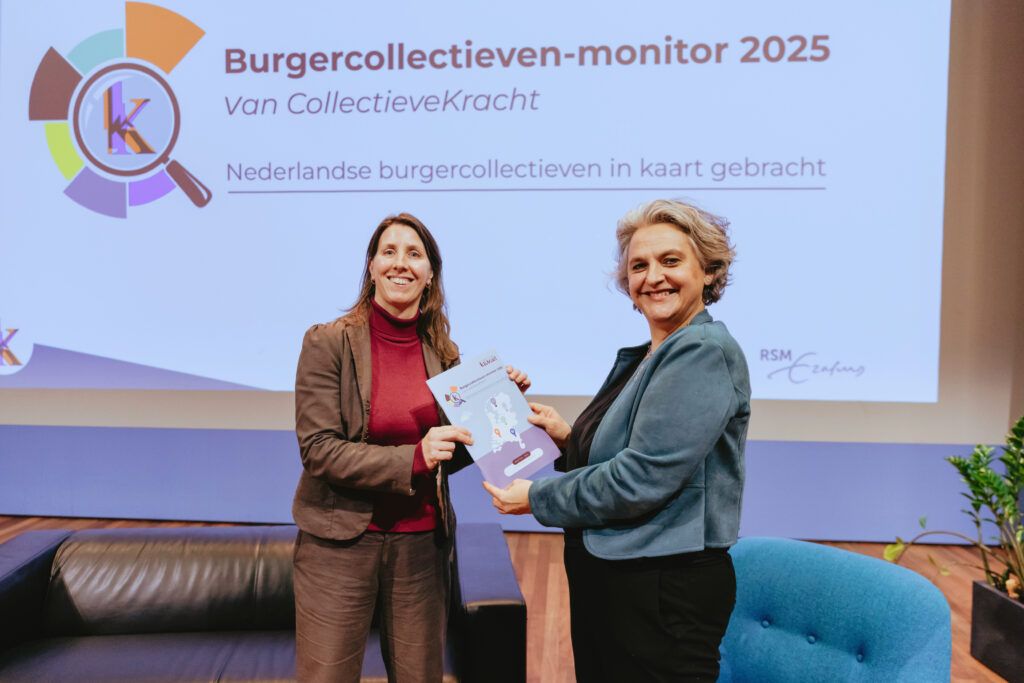
Dive into the data from the first Citizen Collectives Monitor by CollectieveKracht (Dutch publication). Based on information from 431 initiatives, the monitor shows how citizen collectives are increasingly developing into important actors in the public domain.
The first copy was presented on 8 December to Claartje Brons, Programme Manager for Democracy at the Ministry of the Interior. Brons: “When I visit citizen collectives, I see people who want to make a difference, who want to do something meaningful or good, and that happens across many sectors. It is a richness in the Netherlands that is very important and that we can tap into even better. The monitor can help us with that.”

The Netherlands faces major societal challenges. Citizen collectives offer alternative solutions and are playing a growing role in areas such as the energy transition, care innovation, housing initiatives, local food systems, and community democracy. The Citizen Collectives Monitor (open PDF) provides insight into where these initiatives are active, how they function, and what opportunities and bottlenecks they experience.
The monitor paints a broad and in-depth picture of local self-organization in the Netherlands, with analyses of collectives in the energy, housing, care & welfare, and nature, food & agriculture sectors. It offers valuable information for policymakers, civil society organizations and citizens who want to understand how collective action is developing and what support the movement needs.
Key findings from the monitor
Professionalization of the movement
The monitor shows that the past fifteen years have been marked by a strong increase in citizen collectives. These young, local initiatives are increasingly developing into structural societal actors. Many initiatives are joining umbrella organizations and networks, successful models are being replicated and standardized (e.g., Herenboeren), and they combine various activities to better respond to local needs.
Cooperation with government requires mutual understanding
Citizen collectives operate between the market and the government: they are neither, but form their own unique logic based on solidarity, self-organization, and local embeddedness. These different logics sometimes clash. The monitor shows that citizen collectives are eager to cooperate with governments, but this is often difficult. In municipalities where individual civil servants personally connect with the logic of citizen collectives, space emerges for flourishing communities.
Main challenges
The monitor shows that initiatives face multiple structural challenges. Financial constraints are the most common: many initiatives struggle with external funding (65%) and financial independence (56.5%). Internal organization also requires attention. A quarter of citizen collectives find governance and democratic decision-making complex. In addition, keeping active members and volunteers engaged remains difficult. Although initiatives contribute to broad welfare and local cohesion, participation remains socially selective: energy initiatives attract people with higher incomes more often, while care initiatives reach more people with lower incomes.
Institutional foundations still fragile
The most common legal forms are foundations (36%), cooperatives (27%), and associations (26%). Despite growth, the legal and administrative embedding of many initiatives remains vulnerable. Knowledge-sharing, legal advice, and other forms of support are needed to develop sustainable structures. Policymakers, funders, and intermediary organizations can play an important role in this.
More data on sectors, size, and location
The 431 participating collectives are mainly active in: care & social welfare (27.6%), energy (17.9%), housing (15.5%), and food, nature & agriculture (11.4%). A large share of collectives has a substantial membership base: 48% have more than 200 members. Energy and care collectives often have large groups of participants. Citizen collectives are most common in very highly urbanized areas (31.2%), but also in the least urbanized areas (27%). Amsterdam has the most citizen collectives in this monitor, while Horst aan de Maas has the most collectives per inhabitant.