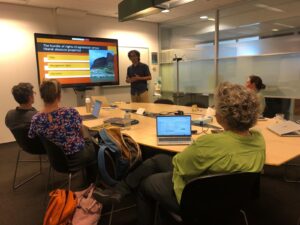
On June 23, Prof. Ismael Vaccaro (CSIC) presented his research about the history of Catalan Commons. The presentation was titled “The Legal Transformations of the Commons in the Catalan Pyrenees: from the Middle Ages until the twenty-first century”.
Vaccaro presented his research on the complex legal history of the old commons, showing how their legal status has been profoundly transformed over time, while certain characteristics have persisted under new legal frameworks.
He demonstrated that the Pyrenean landscape is characterized by a fragmented and complex mosaic of property relations, in which collective forms of ownership remain widespread. Many of these land parcels are still referred to as commons by local residents, scholars, and politicians alike. In reality, however, although these mountain areas were largely managed as commons until as late as the mid-nineteenth century, successive waves of assertive territorial policies implemented by the Spanish state fundamentally altered their legal status. Today, most of the former commons belong either to the state through municipalities or regional governments, or are privately owned by associations of landowners.
At the same time, Vaccaro showed that throughout this process of changing ownership, local communities have, in theory, retained certain usufruct rights over these lands. Where these rights have been maintained, the socio-economic organization of villages has often closely mirrored the structure and rules of the former commons. Similarly, the contracts establishing landowner associations have incorporated usage rules that echo earlier communal arrangements. In addition, over the past twenty years, some municipalities have introduced regulations that recover or replicate aspects of the traditional commons system.