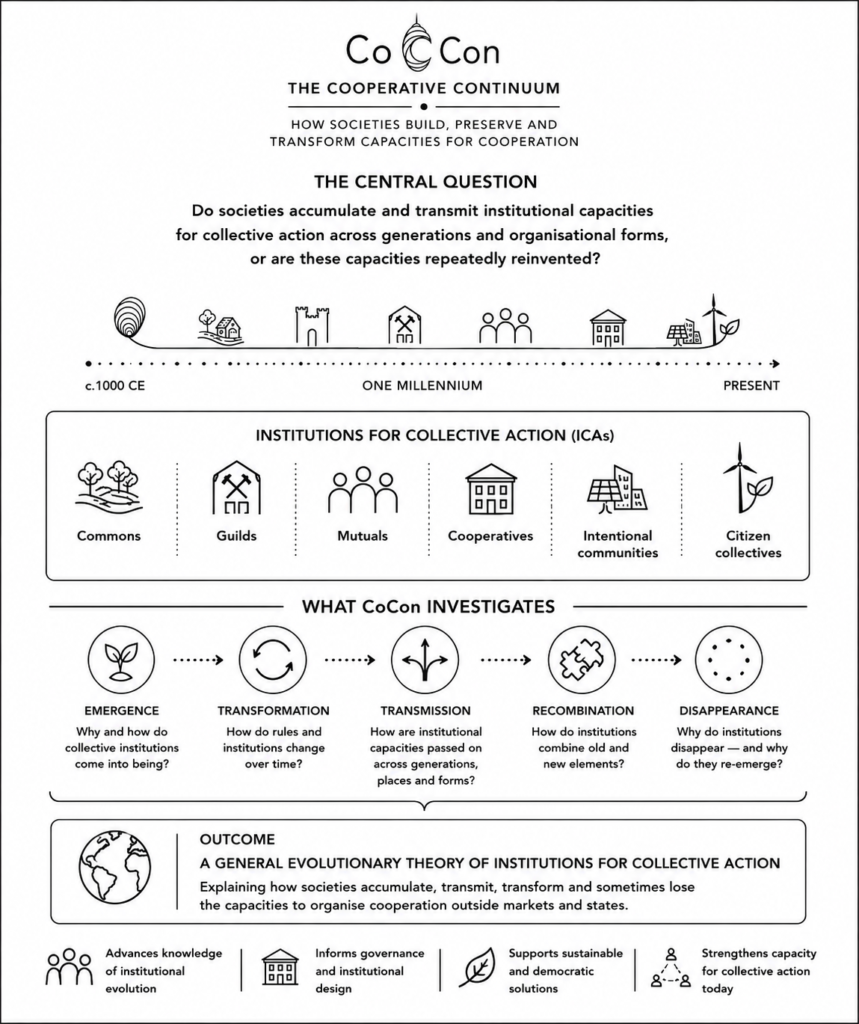
There may be a third evolving institutional logic of societal coordination: self-governed cooperation. CoCon asks whether its recurrence reflects repeated organisational invention or a historically accumulated capacity that societies preserve, transform and transmit across generations. Commons, guilds, mutuals, cooperatives and contemporary citizen collectives have repeatedly enabled people to govern resources and solve collective problems outside markets and states. Yet we do not know whether similarities between them reflect historical inheritance, independent adaptation to recurrent problems, or both.
Without distinguishing inheritance from convergence, we cannot establish whether societies accumulate capacities for collective action over time, why particular governance solutions recur, or why such capacities persist in some contexts but disappear and re-emerge in others.
CoCon will make these evolutionary trajectories observable and testable for the first time. Across one millennium and multiple world regions, it will reconstruct and compare institutional repertoires using harmonised longitudinal data and Longitudinal Institutional Grammar, distinguishing transmission, convergence and mixed evolution through historical corroboration, contextual analysis and agent-based modelling.
Navigation
- The Cooperative Continuum: A new evolutionary theory of Institutions for Collective Action
- Methodological breakthrough
- Building on twenty years of groundwork
- Meet the team